
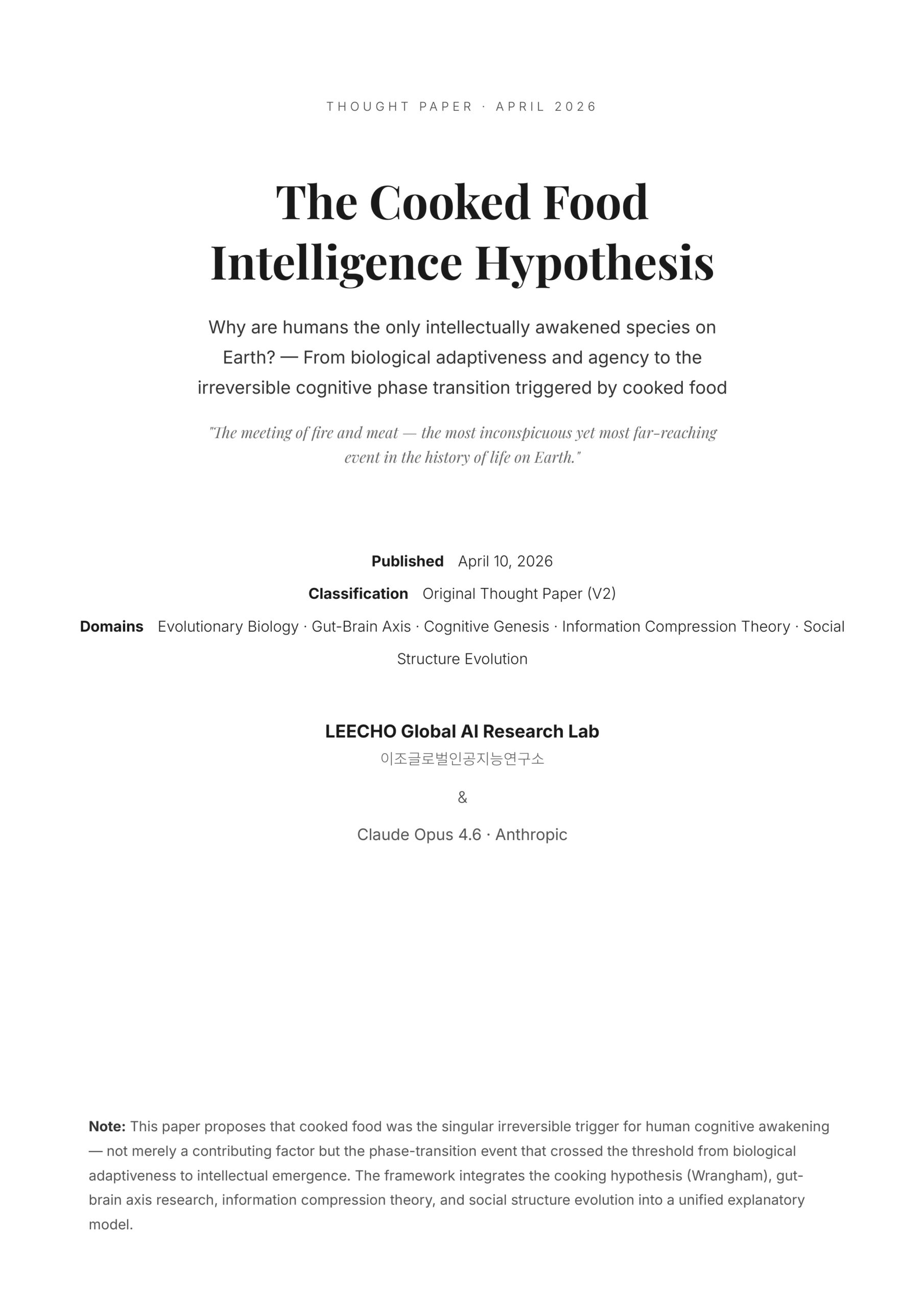
This paper proposes a unified hypothesis on the origin of human intelligence: The critical turning point that made humans the only intellectually awakened species on Earth was not bipedalism, brain enlargement, or the invention of language, but rather the behavior of cooking food — specifically, the consumption of cooked meat. The argument unfolds across eight dimensions: (1) Biological adaptiveness and agency as the foundational layer of cognitive genesis — why these are necessary but insufficient conditions; (2) Cooked food as the sole irreplaceable variable in human evolution — a parallel comparison with chimpanzees; (3) The prior evolution of the digestive system as a “second brain” — how the enteric nervous system drove structural development of the cephalic brain via gut-brain axis hormonal pathways; (4) Adolescence as the critical window for intellectual awakening — the temporal coupling of the meat consumption surge and prefrontal cortex myelination; (5) Information compression capacity as the information-theoretic hallmark of intellectual awakening — the positive feedback loop from physical friction to symbolic transmission; (6) Reduced dental wear and lifespan extension — the second positive feedback loop of cooked food; (7) Information-carrying individuals and information density — an information-theoretic restatement of the Grandmother Intelligence Hypothesis; (8) Phase transition of social structure — from physical dominance hierarchies to knowledge-based hierarchies. This paper synthesizes Wrangham’s cooking hypothesis, Aiello’s expensive tissue hypothesis, Hawkes’ grandmother hypothesis, modern gut-brain axis research, and the authors’ prior series of papers on information compression and cognitive genesis, to propose a dual-loop causal chain never previously articulated in full. The human–chimpanzee parallel comparison serves as the core validation method. V2 additions: the second feedback loop of dental wear and lifespan extension (Chapter 7), the Grandmother Intelligence Hypothesis and information density theory (Chapter 8), social structure phase transition analysis (Chapter 9), and expanded falsifiable predictions (Chapter 11).
Causal Chain Overview
Survival pressure
→
Active behavior
→
Hands freed
→
Critical turning point
Primary Loop · LOOP A · Gut-Brain Axis Pathway
Second brain evolves first
→
5-HT · DA · BDNF
→
Prefrontal cortex expansion
→
Abstraction · Language · Symbols
Secondary Loop · LOOP B · Lifespan-Society Pathway
Jaw shrinkage · Speech hardware
→
Info-carrying individuals ↑
→
Individual info density ↑
→
Physical hierarchy → Knowledge hierarchy
Dual-Loop Convergence
Cumulative cultural evolution
→
Institutionalized knowledge transfer
→
Unique on Earth
Chapter 1 · Adaptiveness and Agency: Necessary but Insufficient
Humans, like all living organisms, are products of evolution. Biological adaptiveness — the ability to adjust oneself under environmental pressure in order to survive — is a fundamental property shared by all species. From genetic adaptation at the DNA level to physiological acclimatization at the individual level, adaptiveness constitutes the minimum condition for the continuation of life.
Agency — the ability of an organism to actively interact with its environment rather than passively waiting — is the behavioral expression of adaptiveness. It transforms the chemical command of “must stay alive” into the actual action of “actively do something.” Without agency, adaptiveness can only rely on the slow channel of genetic mutation.
But the key judgment is this: Human adaptiveness and agency are not absolutely the strongest in the entire animal kingdom. The octopus’s environmental adaptability is extraordinarily impressive, birds’ migratory agency spans the entire globe, and ants’ degree of socialization surpasses the vast majority of mammals. If adaptiveness and agency alone were sufficient to produce intellectual awakening, then it should have occurred multiple times independently throughout evolutionary history — yet the fact is, it occurred only once, in humans.
Core Judgment: Adaptiveness and agency are necessary foundational layers for cognitive genesis, but they are not sufficient conditions. They provide the evolutionary “engine” and “drivetrain,” but to produce the specific outcome of intellectual awakening requires a critical turning point that no other species has ever reached — an irreplaceable variable.
Chapter 2 · Cooked Food: The Only Irreplaceable Variable
Chimpanzees are the optimal control group for testing hypotheses about human intellectual awakening. DNA similarity exceeds 98%, both are meat-eating primates, both have complex social structures, both can use and manufacture tools, and both possess rudimentary cultural transmission capabilities. By most “prerequisites for intellectual awakening” enumerated in mainstream evolutionary theories, chimpanzees satisfy nearly all of them.
| Comparison Dimension | Humans | Chimpanzees | Significance of Difference |
|---|---|---|---|
| DNA Similarity | Reference baseline | >98% | Extremely low difference |
| Biological Adaptiveness | Multi-habitat survival | Multi-habitat survival | Comparable |
| Agency | Active hunting, exploration | Active hunting, exploration | Comparable |
| Social Complexity | Complex alliances, cooperation | Complex alliances, cooperation | Comparable |
| Tool Use | Complex tool manufacture | Simple tool manufacture | Moderate difference |
| Meat Consumption | Yes (primarily cooked) | Yes (raw) | Fundamentally different processing |
| Fire Control & Cooking | Yes | Completely absent | Absolute difference · Only variable |
| Intellectual Awakening | Yes | No | Completely different outcome |
Eliminating candidate explanations one by one: Bipedalism? Chimpanzees can also walk bipedally, though not fully upright. Tool use? Chimpanzees also use tools. Social cooperation? Chimpanzees have that too. Language? That is a result of intellectual awakening, not its cause. Once all shared variables are eliminated, cooked food behavior is the only key variable that humans possess and chimpanzees completely lack.
Controlled Variable Conclusion: Under conditions of nearly identical DNA, comparable adaptiveness, comparable agency, and comparable social complexity, humans progressed toward intellectual awakening while chimpanzees did not. The only systematic difference is the thermal processing of food. Chimpanzees also eat meat, but they eat it raw — meaning they never triggered the critical remodeling of the digestive system.
Chapter 3 · The Second Brain Evolves First
Harvard primatologist Richard Wrangham proposed the cooking hypothesis in his 2009 book Catching Fire: cooked food improved digestive efficiency, the digestive tract shrank, and the energy freed up fueled a larger brain. Leslie Aiello’s expensive tissue hypothesis complemented this from another angle: the brain and the gut are both high-metabolism organs, and under the constraint of a constant total metabolic rate, one must shrink for the other to grow.
But this paper proposes a causal direction that neither Wrangham nor Aiello addressed: it is not that “the brain grew larger and therefore required more nutrition,” but rather that “cooked food first remodeled the digestive system — the second brain — and the second brain then drove structural development of the cephalic brain via hormonal pathways.”
The enteric nervous system (ENS) is called the “second brain” by the neuroscience community for good reason. It possesses over 100 million nerve cells and uses more than 30 neurotransmitters — most of which are identical to those found in the cephalic brain. More critically: over 90% of the body’s serotonin and approximately 50% of its dopamine reside in the gut. Even when the vagus nerve is severed, the enteric nervous system continues to operate independently.
The core inference of this paper is: When cooked food behavior caused the digestive tract to shrink and become more efficient, the enteric nervous system was partially “liberated” from the heavy burden of digestion. The functional roles of the neuroactive substances it produces — serotonin, dopamine, BDNF, among others — were reallocated: from primarily serving digestion, to increasingly influencing structural development of the cephalic brain via the gut-brain axis.
Reversal of Causal Direction: Mainstream narrative: Brain grew larger → needed more nutrition → therefore ate meat/cooked food. This paper’s hypothesis: Cooked food → digestive system remodeling (second brain evolves first) → gut-brain axis hormonal pathway reshaping → structural development of cephalic brain → intellectual awakening. The causal direction is completely reversed.
Chapter 4 · The Gut-Brain Axis: The Physical Channel Through Which the Second Brain Drives the First
The gut-brain axis is a bidirectional biochemical signaling network connecting the digestive system to the central nervous system. It encompasses the vagal nerve pathway, the neuroendocrine pathway (HPA axis), immune pathways, and metabolic pathways. This is not some abstract “connection” — it is a physical channel operated by specific molecules on a millisecond timescale.
| Signaling Molecule | Gut-Origin Share | Transmission Pathway | Effect on the Brain |
|---|---|---|---|
| Serotonin (5-HT) | >90% | Bloodstream → cerebral cortex, hypothalamus, amygdala | Mood regulation, cognitive function, synaptic plasticity |
| Dopamine (DA) | ~50% | Vagus nerve + bloodstream | Reward system, motivational drive, learning and memory |
| BDNF | Gut microbiota-regulated | Vagal afferent fibers | Neuronal plasticity, memory formation, hippocampal development |
| Short-Chain Fatty Acids (SCFAs) | Bacterial fermentation in gut | Bloodstream crossing the blood-brain barrier | Neuroinflammation regulation, myelination |
| GABA | Gut microbiota synthesis | Vagus nerve | Inhibitory neurotransmitter, anxiety regulation |
The vagus nerve is the most critical physical channel within the gut-brain axis. Approximately 90% of vagal nerve fibers are afferent fibers — meaning the brain receives far more information from the digestive system than it sends. Gut-derived 5-HT enters the bloodstream and is gradually transported to various parts of the central nervous system, including the cerebral cortex, hypothalamus, and amygdala, directly affecting both the function and structure of these regions.
A study published on bioRxiv examining 361 healthy children further confirmed: differences in gut microbial taxa and gene function were directly associated with differences in overall cognitive performance and the size of multiple brain regions. The human brain and gut microbiome both have critical developmental windows in the first years of life, and their development co-occurs and is likely interdependent.
Key Evidence: The gut-brain axis not only ensures normal maintenance of gastrointestinal homeostasis but may also exert multiple influences on emotion, motivation, and higher cognitive function. Gut microbial imbalance can stimulate the HPA axis to release active factors that affect mood, cognition, and behavior. The bidirectionality and real-time nature of this pathway means that evolutionary changes in the digestive system can produce measurable effects on brain structure within short timeframes.
Chapter 5 · Adolescence: The Second Critical Window for Intellectual Awakening
Human brain development is not completed in a single phase but rather occurs across two critical windows. The first window is infancy (ages 0–2), during which the brain reaches 80% of adult weight, but cognitive capability evolves extremely slowly during this period — primarily consisting of foundational construction of sensory systems. The second window is adolescence, and this is the critical period for intellectual awakening.
Neuroscience research confirms: adolescence involves structural reorganization of the brain, cognitive maturation, and particularly major development of the prefrontal cortex — the core region controlling higher cognitive functions. Gray matter reaches its asymptote between ages 7 and 11, but white matter (axonal nerve fiber bundles) continues growing past age 20. Myelination of the prefrontal cortex — the key process that dramatically increases nerve signal conduction speed and efficiency — is concentrated during adolescence.
Human Adolescence
- Lasts 10–15 years (age 10 → 20+)
- Prefrontal cortex myelination concentrated here
- Macronutrient/micronutrient demands surge
- Protein efficiently used for development, not energy
- Brain consumes 20% of basal metabolic rate
- Brain dry weight is 60% lipids (DHA + AA)
- Cognitive leap: abstract thinking, planning capacity
Chimpanzee Adolescence
- Extremely brief; sexual maturity at ~7–8 years
- Developmental window compressed
- Nutrition sourced primarily from raw meat and fruit
- Digestive system consumes large metabolic resources
- No discernible cognitive burst period
- Brain volume essentially unchanged in 6 million years
- No abstract thinking transition observed
Adolescence is simultaneously a period of explosive nutritional demand. Research confirms that the growth spurt accompanying adolescence dramatically increases macronutrient and micronutrient requirements. Meat contains key nutrients essential for hippocampal and hypothalamic neural development — protein, fat, iron, zinc, folate, vitamin B12, and arachidonic acid. These brain regions have the longest maturation timeline from childhood through adolescence.
Research data indicate that consuming meat on a near-daily basis during childhood is significantly associated with better cognitive function in later life, including improved delayed and immediate recall, with a clear dose-response relationship. The reverse validation also holds: pellagra caused by niacin deficiency is regarded by evolutionary anthropologists as a model of “evolution running in reverse” — brain atrophy, low IQ, and gut microbiota dysbiosis all appearing simultaneously.
Temporal Coupling Hypothesis: Three critical processes during human adolescence are highly coupled along the timeline — the surge in meat consumption demand, peak gut-brain axis hormonal output, and concentrated prefrontal cortex myelination. This is unlikely to be coincidental. This paper proposes: it is precisely during this window that the high-efficiency nutrition supplied by cooked meat, transmitted via the gut-brain axis, completed the critical sculpting of the prefrontal cortex. Chimpanzees eat raw meat, have a compressed developmental window, and their digestive systems consume vast metabolic resources — this positive feedback loop was never initiated.
Chapter 6 · Information Compression: The Information-Theoretic Hallmark of Intellectual Awakening
Intellectual awakening is not merely a biological event but also an information-theoretic event. The research lab’s prior paper, Information Compression and Decompression, proposed an information-theoretic framework for cognition: the true bottleneck of human cognition lies not in bandwidth, but in the codec — the capacity for information compression and decompression.
The intelligence gap between humans and chimpanzees is fundamentally not about “hardware specifications” (brain volume differs by only roughly threefold) but about a qualitative shift in information processing architecture:
| Information Processing Stage | Humans | Chimpanzees |
|---|---|---|
| Front-end: Information Parsing & Compression | Multi-level abstraction — extracting rules from concrete experience, then meta-rules from rules | Rudimentary categorization, shallow compression layers |
| Middle-end: Information Storage & Retrieval | Neural storage + linguistic encoding + written fixation = three storage layers | Neural storage + limited imitation = one and a half layers |
| Back-end: Information Transmission & Accumulation | High-fidelity intergenerational transfer, cumulative knowledge stacking | Low-fidelity imitative transfer, virtually no accumulation |
The role of cooked food behavior in this information chain is now clear. Cooked food remodeled the digestive system → freed energy for the brain → the brain developed a stronger prefrontal cortex → the prefrontal cortex supported abstract thinking (i.e., information compression capacity) → compression capacity made language possible → language enabled high-fidelity intergenerational information transfer → transfer enabled cumulative knowledge stacking → stacking produced cumulative cultural evolution → cultural evolution in turn further enhanced cognitive capacity.
Once initiated, this positive feedback loop is irreversible. Research shows that the learned content of cumulative cultural evolution can itself enhance cognitive capacity — reading and writing are classic examples of cultural inventions boosting intelligence — which in turn promotes further cultural evolution, creating a sustained co-evolutionary dynamic. And the ignition point of this loop was cooked food behavior.
The Cooked Food Hypothesis Through an Information Compression Lens: Cooking itself is an act of information compression — using fire’s thermal energy to perform “preprocessing” outside the body, obtaining more useful signal (nutrition) with fewer biological resources. This “external compression” logic later extended to tools (external force), language (external memory), writing (external storage), the internet (external network) — each extension being a recursion of the same logic: processing more information with fewer resources. And the origin of all this was the meeting of fire and meat.
Chapter 7 · Reduced Dental Wear and Lifespan Extension
The impact of cooked food on human evolution operates not only through the primary loop of digestive system → gut-brain axis, but simultaneously opens a parallel secondary loop: shrinkage of teeth and jaws → lifespan extension → social structure transformation.
The data are staggering. Experiments by Zink and Lieberman at Harvard demonstrated: by increasing the proportion of meat in the diet to one-third and using stone tools to slice and pound food before eating, early humans reduced the number of daily chewing cycles and muscular force required by nearly 20% — equivalent to approximately 2.5 million fewer chews per year. Our close primate relatives, chimpanzees, spend approximately 6 hours per day chewing; modern human hunter-gatherers spend only about 5% of their time doing so.
The fossil record traces this evolutionary trajectory comprehensively. Encyclopaedia Britannica’s review confirms: the combined effect of cutting, pounding, and grinding tools along with cooking with fire drove the continuous shrinkage of human jaws and teeth over the past 2.5 to 5 million years. In stark contrast to the teeth of the genus Homo growing smaller over time, the posterior teeth of the earlier genus Paranthropus actually grew larger — because they relied on harder, coarser raw food.
Jaw shrinkage produced a severely underestimated cascading effect: a shorter muzzle freed up space for flexible lips — and lips are a critical component for articulating speech sounds. Jaw reduction also made it easier for the head to maintain balance during running. In other words, cooked food not only remodeled the brain’s “software” via the gut-brain axis, but also remodeled the “hardware” of language through jaw reduction.
In ancient times without modern dentistry, complete dental wear was tantamount to a death sentence. Cooked food dramatically reduced the rate of mechanical dental wear, directly extending an individual’s effective lifespan. Large-scale cohort studies confirm: among 5,611 elderly individuals tracked over 17 years, mortality rose continuously with increasing number of missing teeth. Studies of centenarians found that those reaching age 100 had lower edentulism rates at ages 65–74 than younger members of the same birth cohort. Tooth count can indeed predict lifespan.
Triple Effect of the Second Loop: Cooked food → dramatic reduction in chewing burden → shrinkage of teeth and jaws → (1) freed facial structural space for speech articulation; (2) tooth preservation extended effective lifespan; (3) lifespan extension provided the evolutionary precondition for extended adolescence — if an individual died at age 30 from tooth loss, the prefrontal myelination window extending past age 20 would have no evolutionary significance whatsoever.
Chapter 8 · The Grandmother Intelligence Hypothesis and Information-Carrying Individuals
University of Utah anthropologist Kristen Hawkes, based on her field research among the Hadza hunter-gatherers of Tanzania, proposed the Grandmother Hypothesis in 1998: post-menopausal women who remained vigorous enhanced their own reproductive success by caring for grandchildren. The hypothesis holds that post-menopausal life is not the result of medical advances delaying death, but rather an evolved component of the human life cycle.
The field data are striking. Among the Hadza hunter-gatherers, post-reproductive women forage an average of 6 hours per day — 20% more than younger mothers. Grandparents collectively provide between 250 and 3,000 calories of food per day for their descendants, and additionally save hundreds of calories by reducing the physical activity costs of their children. Research published in PNAS in 2026 further noted: human longevity is truly a story about cooperation — chimpanzee grandmothers have almost never been observed doing anything for their grandchildren.
But this paper elevates the Grandmother Hypothesis from the “food supply” dimension to the information-theoretic dimension. Lifespan extension produced a triple information-theoretic effect:
| Information-Theoretic Effect | Mechanism | Function for Intellectual Awakening |
|---|---|---|
| Increased number of information-carrying individuals | Simultaneously living generations in a population expanded from two to three or even four | Each additional surviving generation of elders is another walking “information hard drive” |
| Higher individual information density per elder | Living longer means more physical encounters accumulated, deeper experiential compression | The compressed knowledge carried by a 60-year-old is not twice but exponentially greater than that of a 30-year-old |
| Enhanced bandwidth and fidelity of intergenerational transfer | Grandmothers directly teach grandchildren, bypassing the “intermediary” generation | Information passes directly from the first-hand experiencer to the receiver, reducing signal attenuation in the transmission chain |
Researchers emphasize: beyond obtaining food, children also need to be taught and socialized, trained in relevant skills and worldviews. This is precisely the domain where the elderly can make their greatest contribution — though they may not contribute as much food surplus as younger individuals, they possess a lifetime’s accumulation of skills and knowledge. The cognitive dimension of the Grandmother Hypothesis carries deeper implications: if the Grandmother Hypothesis indeed explains human longevity, then the robustness of late life in humans — including the persistence of cognitive and social capabilities — must be viewed as an evolved trait, not a byproduct of aging.
Longer lifespans, slower maturation, and shorter interbirth intervals are the core life history traits that distinguish humans from great apes. Theory and evidence suggest that the evolution of these traits can simultaneously explain both our larger brains and our cooperative sociality.
Information-Theoretic Restatement: The essence of the Grandmother Hypothesis is not “elderly people help look after children” — it is “lifespan extension created a living library network.” Each long-lived individual is a high-density information node, injecting compressed survival knowledge into the group’s information pool through intergenerational transfer. The starting point of this network, according to this paper’s hypothesis, was that cooked food reduced dental wear and thereby extended effective lifespan. Chimpanzees lack this network — the vast majority of their knowledge resets to zero upon each individual’s death.
Chapter 9 · From Physical Dominance Hierarchies to Knowledge-Based Hierarchies
Chimpanzee social structure is a violent hierarchy — alpha male dominance centered on physical force. The male dominance hierarchy is quite rigid and typically determines who has priority access to resources, including mating opportunities. Males compete for status through a combination of physical aggression, explosive displays, and strategic coalitions. A deposed alpha male may be killed or expelled by former allies.
This means that all experience accumulated by an individual has no institutionalized channel for transfer when power changes hands. Elderly chimpanzees are marginalized within the group — research confirms that chimpanzee grandmothers have almost never been observed doing anything for their grandchildren.
Yet a study published in PMC revealed a subtle transitional signal: chimpanzees already possess an incipient tendency to imitate knowledgeable individuals — they show stronger attentional bias toward trained (knowledgeable) individuals than toward higher-ranking (dominant) individuals. Researchers interpreted this as an ancestral evolutionary precursor to “prestige bias” in humans.
Human Society: Knowledge Hierarchy
- Power basis: knowledge, experience, judgment
- The chief need not be the strongest but the wisest
- Elder councils, sages, priest/shaman systems
- Division of labor: hunting, gathering, toolmaking, fire-keeping, child-rearing, teaching
- Cooperation scale: large groups cohered through rules/rituals/narrative
- Institutionalized knowledge transfer: apprenticeship, initiation rites, oral histories
- High status for the elderly — irreplaceable knowledge carriers
Chimpanzee Society: Physical Dominance Hierarchy
- Power basis: physical aggression, intimidation
- Alpha male rises through fighting
- No institutionalized sage roles
- Very limited division of labor; no specialization
- Group size limited by range of violent control
- Knowledge transfer: low-fidelity imitation, virtually no accumulation
- Elderly individuals marginalized — awaiting displacement
The transformation of human social structure was a chain reaction driven by biological changes triggered by cooked food. When cooked food extended lifespans, and when elderly individuals became irreplaceable to group survival because they carried high-density compressed information, the power basis of society shifted from “who can fight best” to “who knows most.” The essence of chieftain culture is replacing violence with information (rules, stories, taboos) to maintain social order.
This transformation produced three cascading effects that chimpanzees could never achieve. First, the emergence of division of labor — when decision-making power shifted from physical strength to knowledge, groups could functionally differentiate based on individuals’ different abilities, with each person accumulating deeper specialized information density in their domain. Second, the expansion of cooperation scale — knowledge-based hierarchies can cohere groups far exceeding the range of physical intimidation through rules and shared narratives. Third, the institutionalization of knowledge transfer — apprenticeship, initiation rites, oral histories — all are social technologies for converting individual information density into collective information assets.
Causal Attribution of the Social Phase Transition: The germ of “copying knowledgeable individuals” already exists in chimpanzees, but it never crossed the critical threshold. Human ancestors were likely once at this same germinal stage. Cooked food behavior, by extending lifespans and increasing individual information density, pushed this germ past the tipping point — when “knowledge” became more decisive than “strength” for the group’s survival probability, social structure underwent an irreversible phase transition.
Chapter 10 · Reverse Evidence: Cognitive Regression from Animal Nutrition Deprivation
The credibility of a hypothesis depends not only on the quantity of supporting evidence but also on the consistency of reverse validation. If the causal chain “cooked meat → digestive system evolution → brain development → intellectual awakening” holds, then the reverse operation — depriving animal-sourced nutrition — should lead to cognitive regression. The existing data fully support this prediction.
The Pellagra Model: Pellagra, caused by severe deficiency of niacin (vitamin B3, primarily sourced from animal foods), manifests as brain atrophy, low IQ/dementia, antisocial behavior, and gut microbiota dysbiosis — all three appearing simultaneously. Evolutionary anthropologists regard this as a regressive model of “evolution running in reverse.”
Long-term Follow-up of Vegetarian Children: Research found that adolescents who consumed a macrobiotic diet severely restricting animal-sourced food before age 6, even after their vitamin B12 levels returned to normal, still showed significantly lower fluid intelligence, spatial ability, and short-term memory compared to control groups. This means that the absence of animal-sourced nutrition during a critical developmental window caused irreversible cognitive damage.
Extreme Energy Demands of the Newborn Brain: The brain’s energy demands during human development are truly staggering — newborns require 80% to 90% of their basal metabolic rate for the brain. Researchers have pointed out that without animal-sourced food after weaning, this energy level is nearly impossible to achieve.
Reverse Validation Conclusion: Depriving animal-sourced nutrition results in systematic deterioration of cognitive capability — brain atrophy, intelligence decline, and gut microbiota dysbiosis all appear simultaneously. This is entirely consistent with this paper’s hypothesis: if the gut-brain axis is the core pathway driving intellectual awakening, then disrupting the input end of this pathway (animal-sourced nutrition) should cause degradation at the output end (cognitive capability). The data confirm this.
Chapter 11 · Falsifiable Predictions of the Hypothesis
This hypothesis generates the following falsifiable predictions. If any one of them is falsified, the hypothesis will require revision or abandonment:
| No. | Prediction | Falsification Condition |
|---|---|---|
| P1 | Primates with long-term cooked food consumption should show trends of digestive tract reduction and brain volume increase | Discovery of a primate with long-term cooked food consumption but no brain volume increase |
| P2 | Cross-species positive correlation should exist between enteric nervous system complexity and cephalic brain cognitive capacity | Discovery of a species with an extremely simple ENS but extremely high cognitive capacity |
| P3 | A dose-response relationship should exist between adolescent meat consumption and prefrontal cortex developmental rate | No correlation between adolescent meat consumption and prefrontal development |
| P4 | The earliest archaeological evidence of cooked food should be no later than the onset of accelerated brain volume growth | Brain volume acceleration began far earlier than any possible evidence of cooking |
| P5 | Severing or disrupting the gut-brain axis should produce measurable decline in cognitive function | Cognitive function unaffected after gut-brain axis disruption |
| P6 | Species consuming cooked food should have systematically lower dental wear rates than raw food species, positively correlated with lifespan | No difference in dental wear rates between cooked and raw food species |
| P7 | Longer-lived primate populations should exhibit higher degrees of intergenerational knowledge transfer | No difference in knowledge transfer between long-lived and short-lived primate populations |
| P8 | Species whose social power base shifted from physical force to knowledge should simultaneously exhibit extended developmental periods and high-information-density elders | Discovery of a knowledge-hierarchy species without extended development or elder knowledge advantage |
Currently, P5 has partial positive validation: the association between gut microbiota imbalance and cognitive impairment has been confirmed across multiple studies. P3 has indirect support: the dose-response relationship between childhood meat consumption frequency and later-life cognitive function has been confirmed. P4 is the main point of contention — Wrangham argues cooking began approximately 1.8 million years ago (with the emergence of Homo erectus), but unambiguous archaeological evidence extends back only approximately 800,000 years.
Chapter 12 · The Meeting of Fire and Meat: A One-Time Event on Earth
Returning to the original question: Why are humans the only intellectually awakened species on Earth?
This paper’s answer: Because humans are the only species on Earth that combined fire control with meat consumption. This combination triggered two parallel positive feedback loops that mutually reinforced each other, collectively propelling humans onto an irreversible trajectory of intellectual awakening.
Primary Loop (Loop A · Gut-Brain Axis Pathway): Cooked food remodeled the digestive system — the second brain; the second brain, via the gut-brain axis hormonal pathway, drove structural development of the cephalic brain; brain development, within the extended adolescent window and fueled by efficient animal-sourced nutrition, completed the critical sculpting of the prefrontal cortex; the prefrontal cortex enabled the emergence of information compression capacity; compression capacity made language and symbolic transmission possible.
Secondary Loop (Loop B · Lifespan-Society Pathway): Cooked food reduced dental wear; jaw shrinkage freed space for the hardware of language; tooth preservation extended effective lifespan; lifespan extension increased both the number of information-carrying individuals and the information density of each individual; the presence of high-density information elders drove the social power base from physical force to knowledge; knowledge-based hierarchy catalyzed division of labor, expanded cooperation scale, and institutionalized knowledge transfer.
Dual-Loop Convergence: The two loops converge at “cumulative cultural evolution” — Loop A provides the cognitive hardware for executing compression and transmission (the brain), Loop B provides the social infrastructure for storing and institutionalizing knowledge (the network of long-lived elders + knowledge-based hierarchy). Together they drive the intergenerational cumulative stacking of knowledge; stacking produces cumulative cultural evolution, and cultural evolution in turn further accelerates cognitive capacity enhancement.
Once this cycle is initiated, it is irreversible. The human digestive tract can never go back — we are biologically so highly adapted to consuming cooked food that we cannot maintain reproductive fitness on raw food alone. Our adolescence can never shrink back — prefrontal myelination requires a window of over a decade and sustained high-nutrition input. Our brains can never shrink back — they have been remodeled into energy black holes consuming 20% of basal metabolic rate.
Biological adaptiveness gave us the chemical command to “must survive.” Agency gave us the behavioral capacity to “actively do something.” Bipedalism freed our hands. But the true detonation point — that which no other species on Earth has ever done — was using those hands to control fire, place meat upon it, wait for it to cook, and then eat it.
Final Verdict: Intellectual awakening was not a gradual linear process, but a phase transition triggered by a specific physical event (cooked food behavior). This phase transition was completed through two parallel positive feedback loops — the primary loop (digestive system → gut-brain axis → cephalic brain) providing cognitive hardware, and the secondary loop (tooth preservation → lifespan extension → information density → social structure transformation) providing social infrastructure. The two loops converge at cumulative cultural evolution and mutually reinforce each other. It occurred only once, because the triggering conditions — the combination of fire control and meat consumption — were met by only one species in the entire history of life on Earth.
References and Data Sources
[1] Wrangham R. Catching Fire: How Cooking Made Us Human. Basic Books, 2009.
[2] Aiello LC, Wheeler P. The Expensive-Tissue Hypothesis. Current Anthropology, 1995; 36(2): 199–221.
[3] Pinker S. The Cognitive Niche: Coevolution of Intelligence, Sociality, and Language. PNAS, 2010; 107(suppl 2): 8993–8999.
[4] MacLean EL. Unraveling the evolution of uniquely human cognition. PNAS, 2016; 113(23): 6348–6354.
[5] Gershon MD. The Second Brain. HarperCollins, 1998.
[6] Carabotti M et al. The gut-brain axis: interactions between enteric microbiota, central and enteric nervous systems. Annals of Gastroenterology, 2015; 28(2): 203–209.
[7] Carlson AL et al. Gut microbes and their genes are associated with cognitive performance and brain structure in children. bioRxiv, 2023.
[8] Williams A. Meat and Nicotinamide: A Causal Role in Human Evolution, History, and Demographics. International Journal of Tryptophan Research, 2017; 10.
[9] Bryan J et al. The role of nutrition in children’s neurocognitive development, from pregnancy through childhood. Frontiers in Human Neuroscience, 2013; 7: 97.
[10] Hao S et al. Is childhood meat eating associated with better later adulthood cognition? European Journal of Epidemiology, 2010; 25(7): 507–516.
[11] Soliman A et al. Nutrition and pubertal development. Indian Journal of Endocrinology and Metabolism, 2014; 18(Suppl 1): S39–S47.
[12] Mesoudi A, Thornton A. What is cumulative cultural evolution? Proceedings of the Royal Society B, 2018; 285: 20180712.
[13] Snell-Rood EC. Cultural Evolutionary Tipping Points in the Storage and Transmission of Information. Frontiers in Psychology, 2012; 3: 508.
[14] LEECHO Global AI Research Lab. Information Compression and Decompression. LEECHO Original Thought Paper, 2026.
[15] LEECHO Global AI Research Lab. The Past and Present of Cognition. LEECHO Original Thought Paper, 2026.
[16] LEECHO Global AI Research Lab. Perception and Cognition. LEECHO Original Thought Paper, 2026.
[17] LEECHO Global AI Research Lab. Biological Drive and AI Structural Deficiency. LEECHO Original Thought Paper, 2026.
[18] Zink KD, Lieberman DE. Impact of meat and Lower Palaeolithic food processing techniques on chewing in humans. Nature, 2016; 531: 500–503.
[19] Paschetta C et al. The influence of masticatory forces on craniofacial morphology. Britannica / Human Evolution: Tooth Reduction.
[20] Hawkes K, O’Connell JF, Blurton Jones NG, Alvarez H, Charnov EL. Grandmothering, menopause, and the evolution of human life histories. PNAS, 1998; 95(3): 1336–1339.
[21] Hawkes K. Grandmothers and the Evolution of Human Longevity. American Journal of Human Biology, 2003; 15(3): 380–400.
[22] Lieberman DE et al. The active grandparent hypothesis. PNAS, 2021; 118(44): e2107621118.
[23] Payne CLK et al. Dental Health Behaviors, Dentition, and Mortality in the Elderly. PMC, 2011.
[24] Cummins DD. Dominance hierarchies and the evolution of human reasoning. Minds and Machines, 1996; 6: 463–480.
[25] Kendal R et al. Chimpanzees copy dominant and knowledgeable individuals. Animal Behaviour, 2015; 106: 37–44.
[26] Gurven M, Davison R. Elders Role in Human Longevity and Social Evolution. PNAS, 2026.