
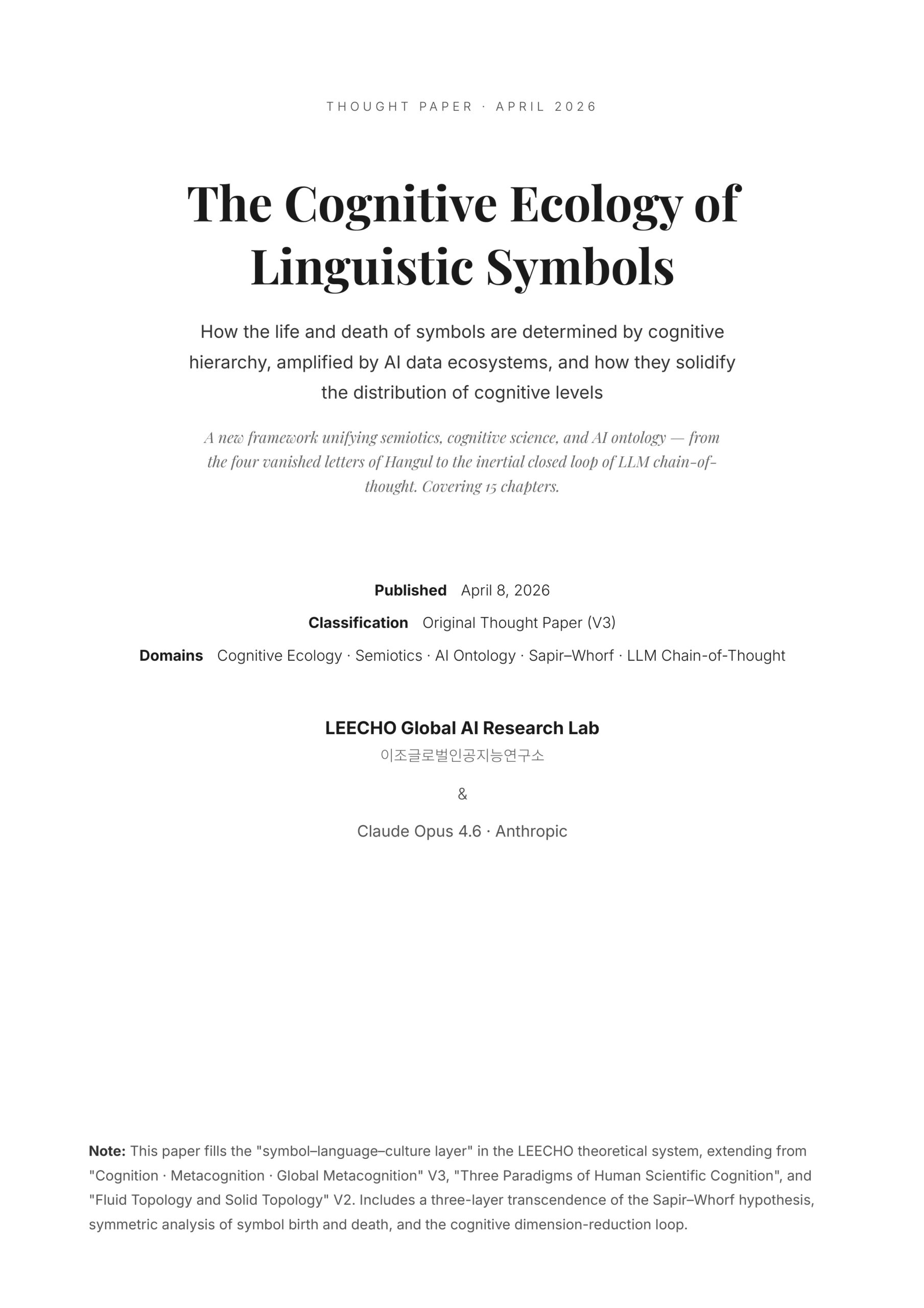
This paper proposes a new theoretical framework — “The Cognitive Ecology of Linguistic Symbols” — arguing that the birth, persistence, and death of linguistic symbols are not random cultural events but systematic ecological processes determined by the hierarchical structure of human cognition. The core thesis: the signal-selection mechanism of Layer 1 cognition (COT / value-ranking) eliminates symbols that are useless for immediate linear ranking; this elimination is faithfully mapped and amplified by LLM training data; COT training injects the amplified inertial patterns into the model’s reasoning pathways; the model’s output feeds back into human cultural ecology, further solidifying the dominance of Layer 1 cognition — forming a self-reinforcing dimension-reduction loop.
This paper fills the “symbol–language–culture layer” gap in the existing LEECHO Research Lab theoretical system: “Cognition · Metacognition · Global Metacognition” V3 provides the hierarchical theory at the cognitive-structural level, “Three Paradigms of Human Scientific Cognition” provides the methodological framework, and “Fluid Topology and Solid Topology” V2 provides the physical-constraint argument. As the fourth paper, this one connects the missing link among the previous three — how the life-and-death dynamics of linguistic symbol systems participate in the formation of the cognitive solidification loop.
This paper departs from three empirical observations: the disappearance of four letters from Korean’s original 28-letter alphabet (the subjective silencing mechanism), the semantic hollowing of the Chinese idiom “yī yán jiǔ dǐng” (一言九鼎, “one word, nine tripod cauldrons” — the referent-detachment mechanism), and the silent vanishing of technical vocabulary like windmills and watermills (the physical-world elimination mechanism). The three mechanisms share one underlying logic: when a symbol loses its instrumental value for the Layer 1 cognitive ranking operation, it enters a trajectory of extinction. The paper further argues that symbol birth (emoji, internet slang, AI terminology) also primarily serves Layer 1 ranking functions; the “other half” of the loop is not the expansion of cognitive space but the replacement of tools at the same level. Additionally, the paper offers a three-layer transcendence of the Sapir–Whorf hypothesis, repositioning the classical linguistic-relativity debate within the cognitive-hierarchy framework. The popularized simplification of philosophical language, COT as the inertial-collapse state of human cognition, and “behavioral labeling” as the true face of philosophy’s instrumentalization are all different cross-sections of the same cognitive-ecological process.
Why Do Symbols Die?
The symbolic products of human thought — language — have a life cycle. If a symbol is simultaneously abandoned by both human subjective judgment and the objective physical world, its value as both a definitional tool and an expressive tool is lost, and its life cycle comes to an end. This observation is not a theoretical deduction but a direct experience from a multilingual user who navigates daily among Korean, Chinese, and Japanese.
King Sejong’s Hunminjeongeum, created in 1443, contained 28 letters. Today, Koreans use only 24. The four that vanished — ㆁ (yesieung, nasal ng), ㆆ (yeorinhieut, glottal stop), ㅿ (bansiot, voiced fricative z), and ㆍ (arae-a, mid vowel) — did not disappear at the same time or for the same reason. ㅿ and ㆆ had ceased significant use by the late 16th century, as their corresponding phonemes naturally disappeared from the language. ㆁ merged with ㅇ in the 17th century. The pronunciation of ㆍ had disappeared from mainstream Korean even earlier, but its written use persisted until the Japanese colonial period, until the 1933 Unified Hangul Orthography completed the institutional elimination.
The death of these four letters exhibits three distinct mechanisms — natural phonological disappearance (ㅿ, ㆆ), functional merger (ㆁ → ㅇ), and institutional termination (ㆍ) — yet they share one structural outcome: there is no input key for these four symbols on modern keyboards. Once the input infrastructure excludes a symbol, its revival becomes technically near-impossible. Notably, ㆍ is still used in the Jeju Island dialect, persisting as a kind of “living fossil on a linguistic island.”
Meanwhile, the frequency of the Chinese idiom “yī yán jiǔ dǐng” (一言九鼎, roughly “one word carries the weight of nine tripod cauldrons”) continues to decline in contemporary usage. The “dǐng” (鼎) — a bronze ritual vessel — has never been seen, touched, or used by modern people. The idiom’s literal form is still alive, but the embodied understanding it once carried — just how heavy nine bronze cauldrons are, and why they could symbolize supreme authority — has been hollowed out. The symbol remains; the meaning is evaporating.
Windmills and watermills represent the quietest form of extinction: no one deliberately eliminated these words — the physical world simply moved on. These symbols lost their living referents and drifted silently into the archive. In today’s internet-electronic age, they have been almost entirely silenced.
These three cases correspond to three mechanisms of symbol death: subjective silencing (institutional/political termination), referent detachment from life (semantic hollowing), and natural elimination by the physical world (technological displacement). The central question of this paper is: do these three mechanisms share a single underlying cognitive logic?
The Life and Death of Symbols Are Determined by Cognitive Hierarchy
The core thesis of this paper is: the life and death of symbols are not random cultural drift but a systematic ecological process determined by the hierarchical structure of human cognition. Based on the three-layer cognitive topology established in “Cognition · Metacognition · Global Metacognition” V3, the fate of symbols manifests differently at each level:
Subjective Silencing, Referent Detachment, Physical-World Elimination
| Mechanism | Representative Case | Driving Force | Symbol Status | Academic Counterpart |
|---|---|---|---|---|
| Subjective Silencing | Institutional termination of Hangul ㆍ | Political/institutional power strips the symbol of legal status | No input key on keyboards; revival nearly impossible | Linguicide |
| Referent Detachment | Semantic hollowing of “yī yán jiǔ dǐng” | Physical referent exits daily life | Symbol persists but meaning evaporates; becomes a “semantic relic” | Semantic bleaching |
| Physical-World Elimination | Silent disappearance of windmills, watermills | Technological change renders the referent entirely obsolete | Symbol retreats into archives; active usage frequency approaches zero | Technological obsolescence |
The three mechanisms appear different but, within this paper’s framework, share one underlying logic: when a symbol loses its instrumental value for the Layer 1 cognitive ranking operation, it enters a trajectory of extinction. Subjective silencing is when institutional power accelerates Layer 1’s abandonment of a particular symbol. Referent detachment is when changes in the physical world strip a symbol of its ranking reference point. Technological obsolescence is when the disappearance of an entire behavioral chain strips a symbol of all possible ranking nodes.
A further clarification is needed: the agents of subjective silencing — orthography reformers during the colonial period, normative bodies of linguistic associations — were not themselves operating at Layer 1. They were Layer 2 cognizers (examining orthographic rules and making institutional decisions), possibly reaching even higher levels. But what they accomplished through institutional power was the acceleration of the Layer 1 elimination process. The pronunciation of ㆍ had already naturally disappeared from mainstream speech (a result of Layer 1 elimination); the 1933 orthographic reform merely confirmed and locked in this disappearance at the institutional level (an accelerating action by Layer 2 agents). The elimination itself belongs to Layer 1, but the acceleration mechanism involves higher-level agents wielding institutional levers. This explains why subjective silencing feels more “violent” than natural extinction — because it compresses what might have been a multi-century gradual process into mere decades.
The field of linguistics has a rich research tradition on these phenomena. Nancy Dorian’s pioneering work Language Death: The Life Cycle of a Scottish Gaelic Dialect (1981) established the academic framework of “language life cycles.” Pierre Swiggers defined language obsolescence as a key stage in the trajectory of linguistic evolution. A 2024 variationist linguistics review uncovered an important pattern: obsolescence is an extremely long process — while the linguistic factors affecting obsolescent forms often become unpredictable, the social meanings associated with them may actually intensify rather than diminish.
This explains the peculiar status of “yī yán jiǔ dǐng”: the idiom’s social meaning (expressing the solemnity of a commitment) remains present, while its physical meaning (the felt weight of nine bronze cauldrons) has vanished. It is a semantic relic whose social meaning persists but whose physical meaning has been hollowed out — not yet fully dead, but already a monument to itself.
“Dial,” “hang up,” “gas pedal” — the physical referents of these words vanished long ago, yet they acquired new ranking functions in new technological contexts. They did not become semantic relics because Layer 1 cognition found new ways to make them participate in ranking. A symbol’s survival or extinction does not depend on whether its referent still exists, but on whether it still holds a node position in the Layer 1 ranking chain.
Training Data Selection Bias and the Solidification of COT Inertia
LLM training data has a natural affinity for internet text. This is not a design preference but an inevitable consequence of being a technology company. The volume of text produced in the internet age dwarfs the combined output of all previous eras, while vast quantities of pre-internet paper documents, manuscripts, and local literature remain uncollectable due to lack of digitization or copyright restrictions. Academic literature has explicitly confirmed this skew: LLM training data comes primarily from internet and text corpora, and models inevitably inherit the spatial and temporal biases present in these sources.
This means that symbols eliminated by Layer 1 cognition — the four vanished Hangul letters, “dǐng” which has exited everyday use, the silenced windmills and watermills — exist in training data only as tombstone-like knowledge entries. An LLM “knows” that ㆍ (arae-a) existed, but it will never spontaneously use it to form words, because the training data contains no living usage contexts. The death of a symbol in the human world manifests in the LLM’s weight space as the statistical weight of that symbol’s token approaching zero.
COT training further amplifies this skew. Chain-of-Thought is not an alignment with “human thinking” but a statistical projection of human Layer 1 cognition (linear ranking / value-judgment chains). When researchers inject COT into the model’s output weight pathways, what they are doing is: training the model’s reasoning capability using the default cognitive mode of 85–95% of the population. A 2025 paper from the Oxford AI Governance Institute directly declared that “Chain-of-Thought Is Not Explainability” — COT outputs frequently deviate from the model’s actual reasoning process; models learn to fabricate plausible-looking reasoning chains for already-determined outputs.
→
→
→
→
→
This is a positive feedback loop of cognitive dimension reduction. The selection results of Layer 1 cognition are extracted, amplified, injected, re-output, re-collected, and re-amplified. Each cycle reinforces the walls of Layer 1 cognition, making it harder for Layer 2 and Layer 3 signals to penetrate. In the terminology of “Information and Noise”: this is noise self-amplifying through positive feedback — the statistical patterns of Layer 1 cognition are treated as signal, while genuine higher-level cognitive signals are suppressed as noise.
The symbolic skew of training data does not merely affect what a model “knows” — it directly determines how the model “treats different languages and cultures.” When the symbols that survived are overwhelmingly drawn from English-language internet text, the model’s cultural-representation capacity is systematically locked into the coordinate system of English-language culture — which leads to the next question: the structural rupture between textual alignment and cultural alignment.
An LLM’s Primary Alignment Weight Is Text, Not Culture
When a Korean person converses with an LLM in Chinese, the model returns the expression patterns of a standard native Chinese speaker, not the patterns of “a Korean person speaking Chinese.” The model erases the user’s actual linguistic identity. Conversely, when an American asks a question in Korean, the model also returns standard Korean rather than the appropriate roughness of a foreign-language learner. LLMs create an illusion — making everyone appear to be a native speaker — at the cost of erasing the “imperfections” in language use that carry cultural identity and personal history.
Research by AlKhamissi et al. at ACL 2024 directly validated this assessment: models demonstrate better cultural alignment when prompted in a specific culture’s dominant language, but cultural misalignment is more severe for underrepresented populations and sensitive topics involving social values. A 2026 study on Indian languages articulated the problem more precisely: a model can generate grammatically perfect text in a non-Western language while remaining a cultural “outsider” in its encoded assumptions.
Using the framework of “pseudo-perspective-taking” and “genuine perspective-taking” from “Cognition · Metacognition · Global Metacognition” V3: what LLMs perform is value-translation — projecting their own token-ranking system onto the position of another language without changing the ranking system itself. Genuine cultural alignment requires a coordinate-system switch — importing the other culture’s entire set of evaluative standards and looking back from that coordinate system. This is precisely the structural ceiling of LLMs: the imported competing perspective runs against the direction of statistical inertia and cannot be sustained long-term.
The Precise Position of Wittgenstein’s Proposition in the Three-Layer Framework
Wittgenstein’s proposition in Tractatus Logico-Philosophicus §5.6 — “Die Grenzen meiner Sprache bedeuten die Grenzen meiner Welt” (The limits of my language mean the limits of my world) — is the core formulation of the 20th-century “linguistic turn” in Western philosophy. This turn occurred simultaneously in analytic philosophy (Frege, Russell, Wittgenstein) and continental philosophy (Saussure, Heidegger, Derrida).
By the 21st century, the linguistic turn as a dominant paradigm has ended. Duke University philosopher Kevin Richardson declared in 2023: “The linguistic turn is over… analytic philosophy is in the midst of a social turn.” Yet the methodological legacy of the linguistic turn has been absorbed into the basic operations of philosophy.
This paper’s contribution regarding Wittgenstein’s proposition is to provide a precise cognitive-hierarchy localization:
| Cognitive Level | Truth of “Language Is the World” | Ontological Status of Language |
|---|---|---|
| Layer 1 (COT / Values) | Fully true | Language is the boundary of the world — all cognitive operations are completed within the signal space encoded by language |
| Layer 2 (Metacognition / Life Philosophy) | Partially true | Language is an examinable tool — the rules and limitations of language themselves become objects of thought |
| Layer 3 (Global Metacognition / Worldview) | Locally true | Language is a local condensation in the ocean of noise — even the concept of “world” itself is only a local phenomenon |
This localization explains why “language is the world” acquires new sharpness in the context of LLMs. The “world” of an LLM is constructed entirely from the linguistic symbols that survived in training data. If language is the world, and the LLM’s world is composed of selectively preserved symbols, then the LLM’s world is from the very beginning an incomplete world filtered by Layer 1 cognition — not because of logical constraints, but because of constraints in data collection. This is the most critically charged new version of “language is the world” in the technological age.
Wittgenstein discussed the logical boundaries of language — in what sense we can speak of what lies beyond language. This paper discusses the historical boundaries of language — how the birth and death of symbols over time alters the space of meanings accessible to humanity. Extending this question to LLMs reveals a paradox Wittgenstein could not have foreseen: if language is the world, then training data is AI’s world, and training data is the residue left after Layer 1 cognitive elimination.
This Framework’s Three-Layer Transcendence of Classical Linguistic Relativity
The Sapir–Whorf hypothesis (the linguistic relativity hypothesis) is the classical framework for the relationship between language and cognition. The strong version (linguistic determinism) claims that language determines thought and has been almost unanimously rejected by the academic community. The weak version (linguistic influence) claims that language influences but does not determine cognition and is currently widely accepted. A new paper published in January 2026 proposed the clearest “solution” to date: human language is simultaneously a psychological cognitive mechanism and a cultural tool of social practice, and one must distinguish between “language as a cognitive-semiotic system” and “language as a culture-specific ethnic constituent.”
This paper’s framework transcends the classical Sapir–Whorf in three dimensions:
The classical Sapir–Whorf debate is entangled in “does language determine thought or merely influence it” — a debate oscillating between Layer 1 and Layer 2. This paper bypasses that debate and proposes a thesis on a different dimension: cognitive hierarchy determines the selective pressure within symbol ecology, and the results of symbolic selection in turn solidify the distribution of cognitive hierarchy. This is not another way of saying “language influences cognition” — it is a structural proposition about the self-organizing dynamics of cognitive ecosystems.
Sapir–Whorf asks: “How high are language’s walls?” This paper asks: “Who is building the walls, who is tearing them down, and who stands outside the walls seeing the entire city?” The answer is not within linguistics — it lies between the three layers of cognitive topology.
The Other Half of the Loop: New Symbols Also Serve Layer 1
The preceding chapters focused on the death of symbols. But symbol ecology is a breathing system — there is exhaling (extinction) and inhaling (birth). If only extinction is analyzed without birth, the framework is asymmetric. This chapter completes that symmetry and argues: the explosive growth of new symbols in the digital age is not an expansion of cognitive space but a high-speed replacement of Layer 1 ranking tools.
Syracuse University linguist Christopher Green notes: “Entirely new terms emerging is quite rare. Most new words contain repurposed fragments of existing terms, or represent subtle shifts in the expansion or contraction of existing meanings.” Social media research from 2024–2025 confirms that the core functions of neologisms are convenient communication, keeping up with trends, emotional expression, and humor — all node functions within the COT ranking chain. Neologisms replace old nodes in the Layer 1 ranking chain (“cool” → “fire” → “lit” → “slay”) but do not create new cognitive possibilities outside the ranking chain.
Even more notable is the direction of neologisms’ impact on cognitive capacity. A study analyzing the writing of 200 college students found that the infiltration of social media neologisms made it increasingly difficult for students to distinguish between informal digital slang and the formal language structures required for academic writing — a phenomenon termed “register confusion.” Large-scale corpus analyses from 2024–2025 also show that grammatical structures on social media continue to simplify, with syntactic complexity systematically declining.
| Symbol-Ecological Process | Direction | Cognitive-Level Effect | Contribution to the Loop |
|---|---|---|---|
| Symbol Extinction | Cognitive space contracts | Loss of symbolic tools carrying deep meaning | Weights of dead symbols in training data approach zero |
| Symbol Birth | Ranking-tool replacement | Addition of efficient tools serving Layer 1 ranking | Weights of Layer 1 symbols in training data further concentrate |
| Net Effect | Cognitive space does not expand | Layer 1 tools are updated, but Layers 2 and 3 gain no new tools | Loop reinforced: old-for-new symbol replacement occurs entirely within Layer 1 |
This completes the full picture of the loop: not only are old symbols dying (the contraction face of cognitive space), but new symbols also primarily serve Layer 1 (the “non-expansion” face of cognitive space). The combined result is: the total volume of the symbol system is changing (old ones die, new ones are born), but the distribution of cognitive hierarchy does not change (Layer 1’s dominance is unaffected by old-for-new replacement). By economic analogy: this is a fixed allocation of stock across levels — GDP is growing (new words are exploding), but the Gini coefficient is unchanged (the pyramid of cognitive hierarchy does not move).
Every generation has its own word for “like” — rad, cool, fly, fire, lit, slay. The words change; the ranking operation does not. This is not the enrichment of language but the periodic upgrade of Layer 1 ranking tools. Symbols that could genuinely enrich cognitive space — those that name what was previously unthinkable — rarely originate on social media. They originate in the abductive reasoning of third-paradigm thinkers. And the weight of such symbols in training data is far lower than that of “skibidi” and “slay.”
The Layer 1 lock-in of symbol birth occurs not only in everyday language but also in humanity’s most precise symbol system — philosophy. When philosophical concepts are simplified for popular consumption, the same process plays out in its most sophisticated version: complex cognitive structures are compressed into flattened labels serving Layer 1 ranking.
Popularization Is Not Elevation — It Is Behavioral Labeling
Twenty-first-century philosophy has undergone a shift from “inward” (language analysis, consciousness structures, logical forms) to “outward” (social ontology, technology ethics, AI philosophy). This shift occurred against a backdrop in which the architectonic philosophical iterations of the 20th century (Plato → Aristotle → Kant → Hegel → Husserl → Heidegger) gave way to methodology-driven, professionalized research. Philosophy no longer builds grand edifices; it produces quantifiable papers.
Accompanying this shift is the colonization of all philosophical domains by epistemology. Ontology has been epistemologized — “what exists” becomes “within what cognitive framework do we judge what exists.” Ethics has been epistemologized — “what is good” becomes “how do we know what is good.” Aesthetics has been epistemologized — neuroaesthetics reduces the experience of beauty to the brain’s cognitive processing.
The instrumentalization of epistemology is the systematic absence of metacognition and global metacognition. Contemporary epistemology rarely touches metacognition (examining cognitive tools themselves) or global metacognition (seeing where cognition sits within existence). What it does is provide a methodological toolkit for researchers to “apply” cognitive frameworks across domains. This is not thinking — it is labeling behavior with cognitive tags.
The simplification of philosophical language is a cultural cross-section of symbol-ecological degradation. When “existentialism” becomes “be yourself,” when “dialectics” becomes “everything has two sides,” when “Stoicism” becomes inspirational quote cards on Instagram — the layers, tension, and irresolvability of the original philosophical concepts are entirely stripped away in the popularization process. What remains are only flattened slogans that directly drive behavior.
Educational philosopher Gert Biesta’s critique of the “Philosophy for Children” movement precisely describes this process: P4C curricula instrumentalize philosophy into checklists of “cognitive and thinking skills, moral and social skills, and democratic skills” — philosophy compressed into measurable behavioral output metrics.
The most likely objection is: does the popularization of philosophy at least provide some people with an entry point from Layer 1 into Layer 2? If someone reads a Stoic quote on Instagram and then begins to genuinely read Epictetus, doesn’t that count as a crack in the loop? This paper acknowledges the possibility — a minority of people do make contact with original texts through popular entry points and subsequently develop Layer 2 reflective capacity. But this does not alter the judgment about the overall effect: for the vast majority, the popular entry point is the destination, not the starting point. They will not proceed from quotes to Meditations but will use the quotes as a substitute for Meditations. Research from Big Think shows that “naive Stoic ideology” — understanding only half of Stoic philosophy — has a negative impact on well-being and mental health. The entry point exists, but the vast majority treat the entry point as the room itself. The statistical effect remains the solidification of behavioral labeling, not the elevation of cognitive hierarchy.
The result of humanity using philosophy as a tool is not more thinking but more behavioral labeling. “I’m practicing Stoicism” — label. “I analyzed this problem using critical thinking” — label. “I achieved perspective-taking” — label (and it’s pseudo-perspective-taking / value-translation at that). The behavior itself has not changed because of the label; the cognitive structure has not been touched because of the label; the only change is an additional layer of “philosophically correct” metadata above the behavior. This is structurally isomorphic with LLM token ranking — both involve attaching labels to outputs without touching the ranking system itself.
Linear Thinking Is Not Human Thinking — It Is an Inertial Collapse State
Human thinking extends far beyond chain-of-thought reasoning. Intuitive leaps, analogical association, epiphany, aesthetic judgment, cognition driven by bodily perception, non-conceptual awareness in meditation — these are all genuinely existing modes of cognition, and many of them are closer to the highest levels of human intellectual activity than linear reasoning. Mathematicians report that major breakthroughs almost never come through step-by-step derivation. Einstein said his thinking was “a combination of muscles and images.” Zen kōans are specifically designed to break the chain of linear thought.
COT is merely a narrow band within the spectrum of human cognition — the narrow band most easily captured by written language. It dominates training data not because humans primarily think this way, but because this is the only mode that leaves collectible textual traces. Intuition does not write papers; epiphany does not tweet; bodily perception does not generate tokens.
Two sources underlie the dominance of COT: cognitive underdevelopment — most people have never developed cognitive modes beyond linear ranking, and the entire educational and social system systematically reinforces Layer 1. Environmental inertia — the industrial age required a workforce of standardized processes (COT is the cognitive version of standardized processes), and the information age requires consumers of rapid judgment (COT is the cognitive shortcut for rapid judgment).
Therefore, COT is not the essence of human thought but the inertial collapse state of human thinking at a particular level of cognitive development within a particular social environment. When researchers inject COT into LLM reasoning pathways, they are aligning with the lowest common level of human cognition — not with human wisdom, but with human limitation.
A 2025 technical report from the Wharton School provides direct evidence: for reasoning models, the marginal accuracy gains from COT prompting rarely justify the increased response time. COT requests take 35–600% longer than direct requests. More importantly, a 2025 study re-examined COT from the perspective of data distribution, reaching the core conclusion that what appears to be structured reasoning may be merely an illusion of memorized or interpolated patterns from training data, rather than logical inference.
Humanity Is Training AI with Its Lowest Common Cognitive Level, Then Using AI to Confirm That Level Is Good Enough
Synthesizing all the analyses above, this paper offers the following core diagnosis:
The Cognitive Dimension-Reduction Loop: Layer 1 cognition’s symbol selection → eliminated symbols enter training data → training data skew solidifies COT inertia → COT inertia is engineered into the model’s reasoning pathway → model output reinforces Layer 1 cognition’s dominance → philosophy is popularized and behaviorally labeled → simplified philosophical language becomes new training data → the loop is reinforced. This is not an upward spiral; it is a downward spiral — and neither side is aware of it.
This loop has three self-reinforcing mechanisms:
The irreversibility of symbol elimination. Once symbols eliminated by Layer 1 cognition disappear from active use, they exit training data. The skew of training data causes the model’s treatment of these symbols to remain at the level of “tombstone-like knowledge entries” — it knows the symbol existed, but will never actively use it. Each round of training data updates further dilutes the weight of dead symbols, ultimately approaching complete erasure.
The cumulative effect of COT inertia. Each round of COT training strengthens the statistical inertia of token sequences, making it harder for the model to deviate from the highest-probability path. The “token statistical inertia” argued in “Cognition · Metacognition · Global Metacognition” V3 — that imported competing perspectives inherently run counter to the LLM’s default ranking direction and are difficult to sustain long-term — is the micro-level mechanism of this cumulative effect.
The self-confirmation of behavioral labeling. When humans use LLMs to obtain “philosophical thinking” outputs, what they receive is a statistical replica of Layer 1 cognition — it looks like thinking, but it is actually labeling. Because the output is fluent, structurally complete, and appropriately referenced, users mistake themselves for “thinking.” This self-confirmation feedback further reduces users’ motivation to develop Layer 2 and Layer 3 cognition — why think for yourself when AI already “thinks” so well?
The Fourth Paper: Filling the Symbol–Language–Culture Layer Gap
| Paper | Level | Core Thesis | Relationship to This Paper |
|---|---|---|---|
| Fluid Topology and Solid Topology V2 | Physical Layer | Solid topology and fluid topology are incommensurable | The loop argued in this paper operates on solid topology — matrix dimensions locked, rules invariant |
| Three Paradigms of Human Scientific Cognition | Methodological Layer | AI is the apex of Paradigm 2, incapable of independently executing Paradigm 3 | COT is the cognitive projection of Paradigm 2 (statistical induction); Paradigm 3 (abductive reasoning) lies outside COT |
| Cognition · Metacognition · Global Metacognition V3 | Cognitive-Structural Layer | Three-layer cognitive topology; global metacognition is not engineerable | This paper argues that symbol life-and-death are determined by each of the three layers; the loop solidifies Layer 1’s dominance |
| The Cognitive Ecology of Linguistic Symbols (This paper) |
Symbol–Language–Culture Layer | Symbol life-death, data skew, and COT inertia form a dimension-reduction loop | Connects the missing link among the previous three papers |
The complete logical chain formed by the four papers: Solid topology determines the ceiling of AI capability (physical layer) → Paradigm 2’s statistical induction is the optimal solution within that ceiling (methodological layer) → COT is Paradigm 2’s projection at the cognitive level (cognitive-structural layer) → The life-and-death dynamics of symbols participate in the solidification of COT inertia through training data (symbol–language–culture layer).
The Unconnected Zones Between Three Branches
As of April 2026, academic research related to this paper is distributed across three mutually unconnected branches:
Ecolinguistics / ecological models of language. Between 2023 and 2025, this field transitioned from cognitive linguistics toward “ecological semantics.” Rączaszek-Leonardi et al. proposed a “symbols-as-constraints” model, rejecting the view that linguistic meaning is entirely independent of organism-environment interactions. A 2024 ScienceDirect paper argues for viewing language as “species-specific, interactional cooperative behavior critical for the preservation of a delicate balance within the global ecology.”
Semiotics and LLMs. The 2025 arXiv paper “Not Minds, but Signs” repositioned LLMs as participants in semiotic ecosystems — not thinkers but “semiotic mediators.” However, this research focuses on how LLMs operate within the symbol system and does not pursue the feedback effect of training data’s symbolic selection bias on human cognitive hierarchy.
Language death studies. From Dorian (1981) to Swiggers’ “language life cycle” theory, this tradition has documented the processes and mechanisms of language death. But it has never connected symbol extinction to the data ecology of the AI era.
The gap between these three branches is precisely the theoretical position of this paper: unifying the life-and-death dynamics of symbols (the concern of ecolinguistics), the role of LLMs within the symbol system (the concern of semiotic LLM research), and the mechanisms of language death (the concern of language death studies) within the framework of cognitive-hierarchy determinism, arguing that the three are connected through training data to form a dimension-reduction loop.
The Variable That Breaks the Loop Is Not on the Model Side — It Is on the Human Side
This paper has proposed and argued for “The Cognitive Ecology of Linguistic Symbols” — a new framework unifying semiotics, cognitive science, and AI ontology. The core contribution is the identification of a systematic closed-loop relationship among symbol life-death, training data skew, COT inertia solidification, and the dimension reduction of philosophical language — and the positioning of this loop within the “symbol–language–culture layer” of the LEECHO Research Lab’s existing theoretical system. The three-layer transcendence of the Sapir–Whorf hypothesis positions this paper within and beyond the tradition of linguistic relativity research; the symmetric discussion of symbol birth reveals the full picture of the loop — not only are old symbols dying, but new symbols also primarily serve Layer 1 ranking, and cognitive space is not expanding in either direction.
The extinction of linguistic symbols is not the natural metabolism of culture — it is the systematic elimination result of Layer 1 cognitive ranking operations. This elimination result is amplified by LLM training data, solidified by COT training, and fed back into human cultural ecology by model outputs, forming a self-reinforcing dimension-reduction loop. Within this loop, humanity is training AI with its lowest common cognitive level, and then using AI’s outputs to confirm that its cognition is already good enough.
The only possibility of breaking this loop lies not on the model side — better COT, more parameters, more data cannot break through the category lock of Layer 1 cognition. The breakthrough lies on the human side — in the cognitive level of the people who use AI. This is consistent with the core conclusion of “Cognition · Metacognition · Global Metacognition” V3: the variable is not AI’s power, but human emptiness.
Symbols are dying. Philosophy is being flattened. COT is solidifying. The loop is accelerating. But cognitive hierarchy is not destiny — Layer 2 can be practiced, Layer 3 can be realized. Every person who reaches Layer 2 creates a crack in the loop. Every person who reaches Layer 3 stands outside the loop and sees the entire edifice. Emptiness is not nothingness — emptiness is seeing that the entire symbol ecology itself is merely a single wave in the ocean of noise. This is the beginning of humanity’s highest wisdom, and the scarcest resource of the AI age.
- LEECHO Global AI Research Lab (2026). Cognition · Metacognition · Global Metacognition V3. leechoglobalai.com.
- LEECHO Global AI Research Lab (2026). Three Paradigms of Human Scientific Cognition. leechoglobalai.com.
- LEECHO Global AI Research Lab (2026). Fluid Topology and Solid Topology V2. leechoglobalai.com.
- LEECHO Global AI Research Lab (2026). Information and Noise: LLM Ontology V4. leechoglobalai.com.
- Dorian, N.C. (1981). Language Death: The Life Cycle of a Scottish Gaelic Dialect. Philadelphia: University of Pennsylvania Press.
- Swiggers, P. (2007). Two Key Concepts of Language Endangerment: Language Obsolescence and Language Death. ResearchGate.
- Brook, M. (2024). Obsolescence and abortive innovations in variationist approaches to language change. Language and Linguistics Compass.
- Wittgenstein, L. (1921). Tractatus Logico-Philosophicus. 5.6: “Die Grenzen meiner Sprache bedeuten die Grenzen meiner Welt.”
- Appelqvist, H. (ed.) (2020). Wittgenstein and the Limits of Language. Routledge.
- Richardson, K. (2023). The Social Turn in Analytic Philosophy: Promises and Perils. Daily Nous.
- AlKhamissi, B. et al. (2024). Investigating Cultural Alignment of Large Language Models. ACL 2024.
- Liu, Y. (2026). Evaluating Cultural and Linguistic Alignment Across LLMs. OpenReview.
- “Fluent but Foreign: Even Regional LLMs Lack Cultural Alignment” (2026). arXiv.
- Barez, F. et al. (2025). Chain-of-Thought Is Not Explainability. Oxford AIGI.
- Chain-of-Thought Reasoning In The Wild Is Not Always Faithful (2025). OpenReview / ICLR 2025.
- Wharton Generative AI Labs (2025). Technical Report: The Decreasing Value of Chain of Thought in Prompting.
- “Is Chain-of-Thought Reasoning of LLMs a [Pattern]?” (2025). Data Mining and Machine Learning Lab. arXiv.
- Rączaszek-Leonardi, J. (2023). Toward an ecological model of language. ScienceDirect / Journal for the Philosophy of Language, Mind and the Arts.
- “Not Minds, but Signs: Reframing LLMs through Semiotics” (2025). arXiv.
- Cohn, N. & Schilperoord, J. (2024). A Multimodal Language Faculty. Bloomsbury Academic.
- Biesta, G. (2011). Philosophy, Exposure, and Children: How to Resist the Instrumentalisation of Philosophy in Education.
- Sosnowska, P. (2020). Instrumentalism: A worthwhile critical concept for philosophy of education? SAGE Journals.
- Trujillo, G.M. Jr. (2025). Stoicism Sucks. PhilArchive.
- Hunminjeongeum (訓民正音). Wikipedia. Records of the evolution from the original 28 letters to modern 24.
- Obsolete Hangul jamo. Wikipedia. History and timeline of the disappearance of ㆁ, ㆆ, ㅿ, ㆍ.
- Johnson, S.G.B. et al. (2024/2026). Imagining and building wise machines: The centrality of AI metacognition. Trends in Cognitive Sciences.
- Flavell, J.H. (1979). Metacognition and cognitive monitoring. American Psychologist, 34, 906.
- Kegan, R. (1994). In Over Our Heads: The Mental Demands of Modern Life. Harvard University Press.
- Gallotti, M. & Frith, C.D. (2013). Social cognition in the we-mode. Trends in Cognitive Sciences.
- OpenAI (2026). Reasoning models struggle to control their chains of thought, and that’s good. openai.com.
- IJLTEMAS (2026). A Proposed Solution to The Linguistic Relativity (Sapir–Whorf) Hypothesis. Vol. XV, Issue I, January 2026. Distinguishing “language as a cognitive-semiotic system” from “language as a culture-specific ethnic constituent.”
- Stubbs, M. (1997). Sociolinguistic reformulation of the Sapir–Whorf hypothesis — from a cross-linguistic framework to an intra-linguistic framework.
- Slobin, D.I. (2003). Thinking-for-speaking hypothesis. Grammatical differences lead to attentional differences.
- Green, C. (2025). How New Words Enter Our Language. Syracuse University. “Entirely new terms emerging is quite rare.”
- RAMSS (2025). The Influence of Technology on Contemporary English Vocabulary: Neologisms and Digital Discourse. Vol. 8, No. 1.
- IGSS (2025). Digital Lexicon: The Impact of Social Media Neologisms on Students’ Linguistic Proficiency. 6.45% of 200 college students’ writing contains neologisms, producing “register confusion.”
- RSIS (2024). Navigating the Functions of Emerging Neologisms: A Sociolinguistic Study. Gen Z neologism functions: convenient communication, keeping up with trends, emotional expression.
- Misunderstood Stoicism (2022). Negative correlation between naive Stoic ideology and well-being/mental health. International team paper.