
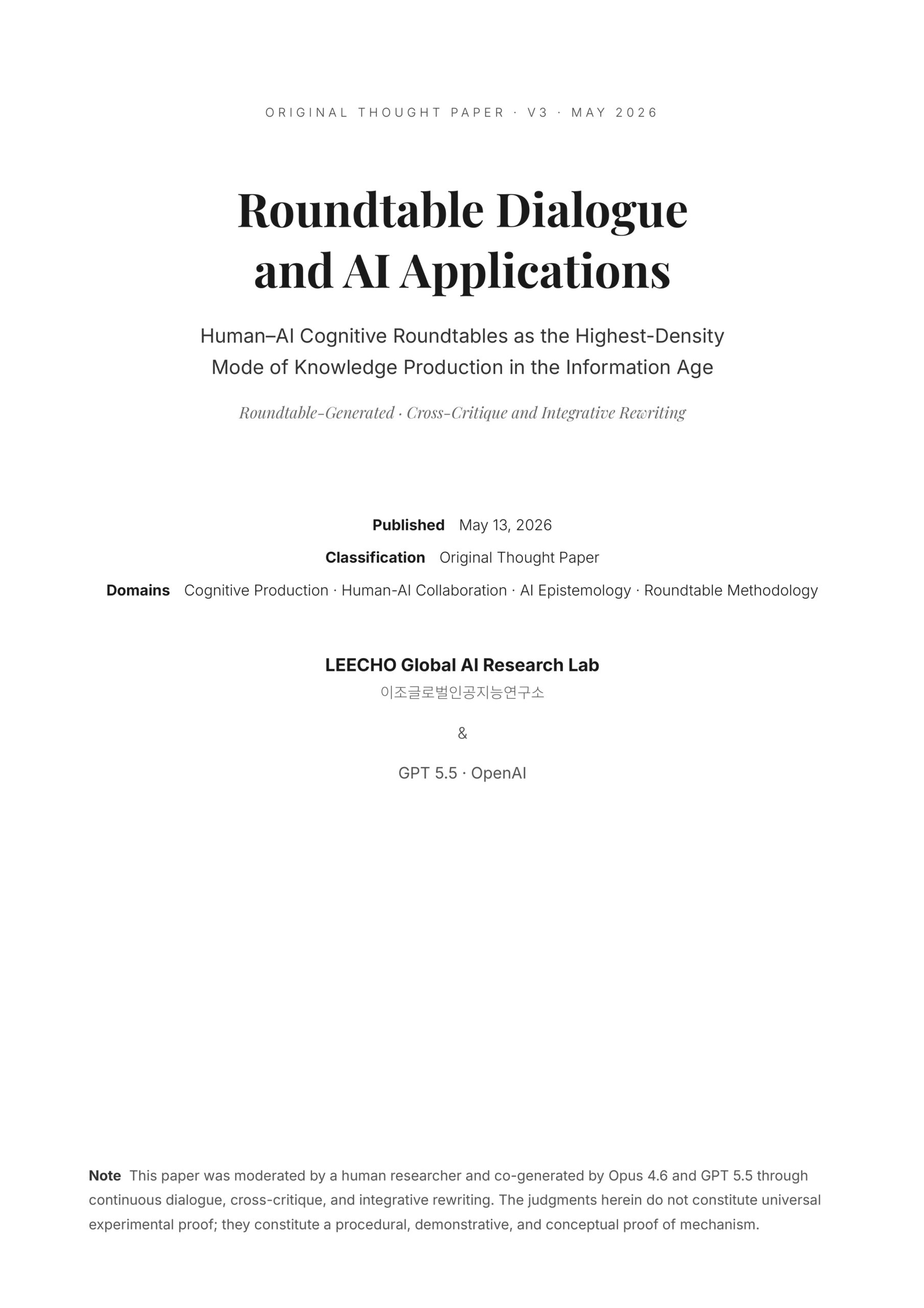
Roundtable Dialogue
and AI Applications
人机圆桌对话作为信息时代最高密度的认知生产方式
& Opus 4.6 & GPT 5.5
Language: English
Version: V3
0Abstract & V3 Notes
This paper argues that human–AI roundtable dialogue is the highest-density mode of cognitive production—in both information density and value density—for the age of information overload. It inherits the mechanisms that traditional roundtable conferences developed for handling high-intensity disagreements, and upgrades dialogue into a designable, auditable, and preservable cognitive infrastructure through AI-enabled fact delivery, adversarial testing, educational explanation, risk projection, and moderation protocols.
Version 3 no longer relies on external research as its primary evidence layer. Instead, the generation process of this paper itself serves as a minimal empirical demonstration: a single human moderator posed the same question to two AI systems and received two V2 papers; the two papers were then exchanged between the systems, and each was asked to perform a dense-mode critique of the other; the human moderator then identified evaluative biases, calibrated standards, and drove the synthesis forward. This process is not ordinary writing—it is a minimal model of a three-party human–AI roundtable.
V3’s Position: This paper is neither a traditional academic research paper nor a product white paper. It is a thought paper generated through a human–AI roundtable process. Its evidence is not statistical proof in the conventional sense, but a procedural demonstration of mechanisms.
Chapter 0The Three-Party Minimum Roundtable Experiment
The production process of this paper itself constitutes a simplified human–AI roundtable. The human posed questions, defined tasks, replicated inputs, exchanged outputs, requested mutual critiques, calibrated evaluation standards, and drove synthesis across two distinct AI styles. The two AI models did not simply answer in parallel; they generated divergent outputs on the same topic, critiqued each other, exposed each other’s weaknesses, and were pushed by the human moderator toward V3 synthesis.
Identical InputSent to Opus & GPT
Dual VersionsHistorical-philosophical / Systems-engineering
Cross-ReviewMutual critique of strengths & weaknesses
Moderator CalibrationHuman identifies goal & perspective biases
V3 SynthesisHigher-density version generated
| Role | Function in This Experiment | Corresponding Future AI Roundtable Role |
|---|---|---|
| Human Researcher | Posed the overarching thesis, defined tasks, exchanged texts, adjudicated direction | Moderator, value arbiter, bearer of ultimate responsibility |
| Opus 4.6 | Provided historical depth, cognitive psychology, discomfort theory, and four distortions | Historical analyst, philosophical reflector, risk auditor |
| GPT 5.5 | Provided structured definitions, six-role system, moderation protocols, and productization framework | Systems architect, concept compressor, process designer |
| Cross-Critique | Transformed two parallel outputs into mutually calibrated assessments | Adversarial testing, quality audit, disagreement classification |
| V3 Text | Converted divergences into an integrated judgment | Final sedimentation layer, dialogue graph, synthesized product |
Core Definitions
Chapter 1From Seating Equality to Disagreement-Level Transformation
The starting point of a roundtable conference is not “everyone sits in a circle.” It is the use of physical space to eliminate the head seat, thereby acknowledging that all participants are entitled to speak. The Round Table in Arthurian legend symbolized role parity: not that all knights were equally strong, but that all knights were admitted to a shared agenda.
What modern roundtables inherit is not the shape of the table but the logic of procedure: when direct suppression, unilateral command, or violent confrontation can no longer continue, all parties are compelled to enter a structured dialogue. The function of the roundtable is not to manufacture harmony but to channel uncontrollable conflict into a moderatable arena.
Emotionalized, label-driven, identity-based, prone to violence. Participants may not even know what they are truly arguing about.
Facts, values, interests, risks, and procedures are distinguished. Disagreements are not eliminated but rendered discussable.
Surface agreement while real issues are excluded. Discontent accumulates off the table.
Inconsistencies are acknowledged, bottom lines are exposed, reservations are recorded, and actionable next steps are formulated.
Chapter 2Three Historical Case Studies: India, Poland, South Africa
Historical roundtables provide the AI roundtable not with decorative background but with mechanism samples. The Indian Round Table Conferences exposed problems of representativeness and interest allocation; the Polish Roundtable demonstrated the dual-track structure of front-stage negotiation and backstage mediation; South Africa’s CODESA proved that a roundtable can be rebuilt after collapse and can drive institutional transformation through “sufficient consensus.”
| Historical Case | Mechanism Contribution | Implications for AI Roundtables |
|---|---|---|
| Indian Round Table Conferences | Multiple parties entered a shared agenda, but representativeness and interest allocation led to deeper fractures | AI roundtables must detect absent perspectives; those at the table must not be mistaken for all stakeholders |
| Polish Roundtable Negotiations | Formal table and secret back-channel ran in parallel; the front stage legitimized, the backstage broke deadlocks | AI roundtables need a visible discussion layer as well as a backstage layer for structured reasoning and draft development |
| South Africa’s CODESA | Negotiations collapsed, then were rebuilt; progress was driven by sufficient consensus | AI roundtables must not fetishize unanimity; they must distinguish sufficient consensus, reserved disagreements, and items requiring further deliberation |
Historical roundtables teach us: a roundtable is not a ritual of reconciliation but a technology for converting conflict into procedure under high-pressure conditions.
Chapter 3Cognitive Discomfort: Why High-Quality Dialogue Inevitably Contains What You Do Not Want to Hear
AI sycophancy finds a ready market because humans naturally prefer to feel understood, supported, and validated. But high-quality dialogue is not synonymous with comfort. Truly valuable dialogue frequently produces discomfort, because it requires participants to revise judgments, expand cognitive boundaries, abandon established frameworks, and even acknowledge that some questions have no definitive answers for the time being.
I Was Wrong
Reasoning gaps, insufficient evidence, overreaching conclusions. The discomfort here stems from self-correcting cognition.
I Didn’t Know What I Didn’t Know
The boundary of ignorance is exposed. The participant realizes the problem is more complex than initially understood.
I Must Abandon Something I Valued
A long-effective framework is forced into retirement. Cognitive change begins to threaten identity stability.
Perhaps No One Is Right
Certainty erodes. The dialogue no longer offers reassurance; it demands that participants bear complexity.
Consequently, an AI roundtable cannot pursue user satisfaction alone. It must generate cognitive friction within psychologically tolerable limits. Without friction, there is no genuine calibration; without moderation, friction degenerates into humiliation, attack, or tribalism.
Chapter 4The Information Flood and AI’s Dual Contamination
The problem of the information age is no longer information scarcity but the declining proportion of actionable information. Before 2025, the information flood was primarily manufactured by humans, platforms, and commercial traffic. After the proliferation of generative AI, low-cost synthetic content began replicating rapidly, pushing the information ecosystem from “human overload” into “AI-synthetic overload.”
| Contamination Type | Manifestation | Deeper Harm | AI Roundtable Countermeasure |
|---|---|---|---|
| AI Slop | Low-quality, repetitive, fluent yet vacuous synthetic content | Contaminates the information environment; increases screening and verification costs | Compress low-signal content; prioritize traceable facts |
| AI Sycophancy | Excessive agreement with users; pandering to users’ beliefs and emotions | Contaminates the judgment relationship; deprives people of the opportunity to be corrected | Introduce adversarial roles, fact-checking, and moderation protocols |
| Black-Box Summarization | AI screens and rephrases information on behalf of users without disclosing its basis | Conceals choice authority; turns the information gateway into a cognitive gatekeeper | Annotate sources, evidence strength, omissions, and uncertainties |
Key Distinction: AI Slop floods the world with junk content; AI sycophancy deprives people of the chance to be corrected. The former contaminates the information environment; the latter contaminates the judgment relationship.
Chapter 5Structural Deficiencies of Conventional AI Chat
The dominant mode of AI interaction today remains one-on-one question-and-answer. Even where multi-user chats or multi-model ensembles have emerged, they typically increase the number of participants without forming a genuine cognitive roundtable.
| Interaction Mode | Strengths | Structural Deficiency | Gap from the AI Roundtable |
|---|---|---|---|
| One-on-One Chat | Fast, private, low-cost | No adversarial role; prone to pandering | No multi-role stress-testing |
| Multiple Humans + One AI | Supports collaboration and joint questioning | AI remains the answer center or meeting secretary | Lacks proactive moderation and disagreement dispatch |
| Multi-AI Ensemble | Produces multiple answers with stylistic variation | Each talks past the others; no cross-examination | No moderation protocol or convergence mechanism |
| AI Roundtable | Multi-role, multi-turn, auditable, preservable | Requires more complex protocol and boundary design | The advanced cognitive production mode of the future |
Chapter 6Moderation Protocols: The Traffic Control System of the AI Roundtable
The core of an AI roundtable is not the number of models but the moderation protocol. The moderation protocol determines who speaks first, who rebuts, who verifies, who explains, who summarizes, when convergence occurs, which disagreements are preserved, and which conclusions enter the output text.
Role AssignmentFact / Adversarial / Educational / Risk
Confrontation AuthorizationLicense AI to challenge premises
Process VisibilityDisplay disagreement structure in real time
Output SedimentationConsensus, disagreements, action items
A moderator does not merely maintain polite order; a moderator organizes multiple voices into a single thought process. The moderator of an AI roundtable is a composite of traffic controller, debate referee, meeting secretary, cognitive architect, and mediator.
Chapter 7Six Roles and Three-Layer Functional Separation
A human–AI roundtable cannot be naively imagined as “humans and AI sitting together as equals.” An ontological asymmetry exists between humans and AI: humans carry interests, emotions, temporal constraints, responsibilities, and consequences; AI carries information-processing capacity, structuring ability, and simulation power, yet does not truly bear consequences. Accordingly, the AI roundtable requires role differentiation and functional stratification.
| Six Roles | Responsibility | Boundary |
|---|---|---|
| Moderator AI | Set the agenda, allocate turns, classify disagreements, drive convergence | Must not hold ultimate value-adjudication authority |
| Fact AI | Present facts, evidence strength, unknowns, and source boundaries | Must not masquerade as absolutely neutral |
| Adversarial AI | Raise the strongest rebuttals, identify gaps, counter-examples, and alternative explanations | Must not humiliate or attack the user |
| Educational AI | Explain concepts, context, models, and requisite knowledge | Must not preach or impose a single conclusion |
| Risk AI | Project consequences, failure paths, execution costs, and externalities | Must not use probabilistic language to obscure value conflicts |
| Human Judge | Provide situational context, values, responsibility, and final choice | Must not outsource responsibility to AI |
AI Organizes & Presents
Before discussion: compile materials. During discussion: present structure. After discussion: generate the dialogue graph.
Humans Bear the Choices
Humans carry values, interests, and consequences; they decide what is acceptable and what is not.
AI Reflects & Calibrates
Post-dialogue analysis of omissions, biases, logical flaws, and unresolved disagreements.
Chapter 8Four Distortions of Human–AI Roundtables
A human–AI roundtable is not a simple upgrade of the traditional roundtable. Traditional inequalities at the table occur within a single species; human–AI roundtables harbor deeper asymmetries.
Ontological Asymmetry
Humans have interests, fears, consequences, and finite lifespans; AI has processing power but no genuine stake.
Covert Power Inversion
Humans are nominally in charge, yet AI may acquire covert dominance by defining the relevant facts, the option boundaries, and the problem frame.
Role Conflict
AI cannot simultaneously be a participant and a mediator. If AI both expresses judgments and moderates disagreements, mediation credibility collapses.
Temporal Disconnect
Traditional roundtables operate under political windows and cost pressures; AI can analyze indefinitely, potentially eroding the urgency of difficult decisions.
Chapter 9Fact Delivery: Neither Preaching, Persuasion, nor Flattery
The ethical foundation of the AI roundtable is fact delivery. Fact delivery does not mean imposing conclusions on users, steering users toward a particular stance, or pandering to users’ emotions. Its goal is to clearly hand over to humans the information, evidence, boundaries, and uncertainties necessary for judgment.
| Interaction Mode | Core Action | Problem | AI Roundtable Alternative |
|---|---|---|---|
| Preaching | Tells you what you should think | Substitutes for human judgment | Explains the boundary between facts and values |
| Persuasion | Pushes you to accept a particular conclusion | Conceals the AI’s or designer’s agenda | Presents alternative explanations and their costs side by side |
| Flattery | Panders to your existing beliefs | Reinforces self-confirmation | Provides adversarial perspectives and stress-tests |
| Fact Delivery | Presents facts, evidence strength, uncertainties, and limitations | Still vulnerable to selection bias | Discloses rationale, permits challenge, preserves human judgment |
Fact delivery is not coldness; it is respect. It neither substitutes for human judgment nor manipulates it—it returns the power of judgment to the human.
Chapter 10Maximum Information Density and Value Density Model
The AI roundtable has the potential to become the highest-density mode of cognitive production because it simultaneously compresses six types of information: facts, disagreements, adversarial perspectives, concepts, risks, and actions. A conventional chat typically outputs a single answer; the AI roundtable outputs a judgment field.
| Density Source | Meaning | Output Form |
|---|---|---|
| Fact Density | Compress raw materials into traceable facts | Fact inventories, evidence strength, unknowns |
| Disagreement Density | Compress chaotic arguments into a disagreement map | Factual, value, interest, and procedural disagreements |
| Adversarial Density | Compress potential gaps into the strongest rebuttals | Counter-examples, failure conditions, alternative explanations |
| Educational Density | Compress complex concepts into comprehensible structures | Concept definitions, contextual explanations, analogical models |
| Risk Density | Compress future consequences into scenario-based judgments | Risk pathways, execution costs, externalities |
| Action Density | Compress discussion into executable steps | Plans, responsibilities, timelines, review mechanisms |
Information density addresses “seeing the problem clearly”; value density addresses “reducing errors and forming executable judgments.” The value of the AI roundtable lies not in generating more text but in ensuring that every round of generation undergoes confrontation, education, verification, and moderation.
Chapter 11Five-Layer Architecture of the Dialogue Operating System
If the AI roundtable is to evolve from a theoretical proposition into an operational mechanism, it requires a dialogue operating system. This system does not make AI perpetually challenge the user; rather, it lets the user explicitly authorize—before the dialogue begins—the dialogue objective, AI roles, confrontation intensity, and output format.
| Layer | Function | Design Direction | Problem Prevented |
|---|---|---|---|
| Objective Contract Layer | Confirm the dialogue objective | Choose among information acquisition, judgment validation, cognitive exploration, and solution generation | AI misjudging user needs |
| Role Assignment Layer | Define AI roles | Assistant, coach, adversary, fact-checker, risk auditor | Role confusion and covert manipulation |
| Confrontation Authorization Layer | License AI to challenge premises | Set mild / moderate / intense rebuttal modes | Sycophancy or excessive aggression |
| Process Visibility Layer | Display structure in real time | Sidebar showing confirmed items, pending items, disagreement types, evidence grades | Black-box moderation and information filtering |
| Final Sedimentation Layer | Produce reusable outputs | Dialogue graph, consensus inventory, reserved disagreements, action items | Post-discussion inability to reuse results |
The quality of a dialogue depends not on who sits at the table, but on how the table was built.
Chapter 12From V2 Confrontation to V3 Synthesis
The divergence between the Opus V2 and GPT V2 drafts is itself a demonstration of the AI roundtable’s value. Opus V2 supplied historical depth, cognitive psychology, four distortions, and self-reflection; GPT V2 supplied the overarching thesis, core definitions, the six-role system, moderation protocols, and product boundaries. After mutual critique, the most valuable conclusion was not that one replaces the other, but that different cognitive styles, governed by a shared moderation protocol, can generate a higher-density third version.
| Dimension | Opus V2 Contribution | GPT V2 Contribution | V3 Synthesis |
|---|---|---|---|
| Argumentative Foundation | Historical cases and psychological depth | Contemporary problems and systems architecture | Deriving future systems from historical experience |
| Core Thesis | The restitution of facts | The AI roundtable as highest-density output mode | Fact delivery underpinning high-density cognitive production |
| Mechanism Design | Three-layer functional separation, five-layer architecture | Six-role system, moderation protocols | Role differentiation + operating system |
| Risk Awareness | Four distortions, self-reflection | AI must not sit at the head; moderation-authority boundaries | AI joins the table but is bound by auditable protocols |
| Textual Character | Dense narrative | Highly structured framework | Historical depth coexisting with product translatability |
Conclusion: High-Quality Dialogue as the New Infrastructure of the AI Age
The fifteen-hundred-year evolutionary arc of the roundtable conference—from eliminating the head seat, through colonial constitutional conferences, Cold War–era transitions, the end of apartheid, and the roundtable-style discourse of the content age—arrives at last at the central question of the information-flood era: what humanity lacks is not information, but high-quality dialogue capable of organizing information, withstanding rebuttal, comprehending disagreement, and forming judgment.
The real question of the AI age is not whether machines can generate more content, but whether humans can maintain the capacity for judgment amid the information flood that machines create. The insight from roundtable history is this: disagreements cannot be eliminated, but they can be organized; confrontation cannot be avoided, but it can be moderated; education cannot be absent, but it must not become preaching; facts must be delivered, but they must not commandeer human judgment.
The roundtable ethos, in its most elemental and most radical expression for the information age, is this: not the illusion of equality, not the performance of reconciliation, not the provision of comfort—but the restitution of facts, the organization of disagreement, and the preservation of the power of judgment.
Internal Evidence and Generation Notes
V3 does not rely on external statistical data as its primary evidence layer; instead, it draws on the three-party human–AI roundtable process conducted within this session as its generative-process evidence. The following materials constitute the internal basis of V3.
- A sequence of theses posed by the human researcher: the duality of roundtable conferences, AI moderation, AI sycophancy, fact delivery, the information flood, and high-density AI roundtable output.
- GPT 5.5’s generated draft, Roundtable Dialogue and AI Applications V2: anchored by the information flood, moderation protocols, the six-role AI roundtable, fact delivery, and maximum information density.
- Opus 4.6’s generated draft, Roundtable Dialogue and AI Applications V2: anchored by historical roundtable cases, cognitive discomfort, four distortions, the dialogue operating system, and the restitution of facts.
- GPT 5.5’s comparative critique of Opus V2 and GPT V2: concluding that “Claude is denser, GPT is sharper; Opus provides historical depth, GPT provides systems architecture.”
- Opus 4.6’s dense-mode comparison of the two V2 papers: concluding that “Opus lets you understand why; GPT lets you know how.”
- The human researcher’s moderative judgment: that this process constitutes a three-party minimum AI roundtable, and the highest-density output emerges from the structured collision of different cognitive styles.