
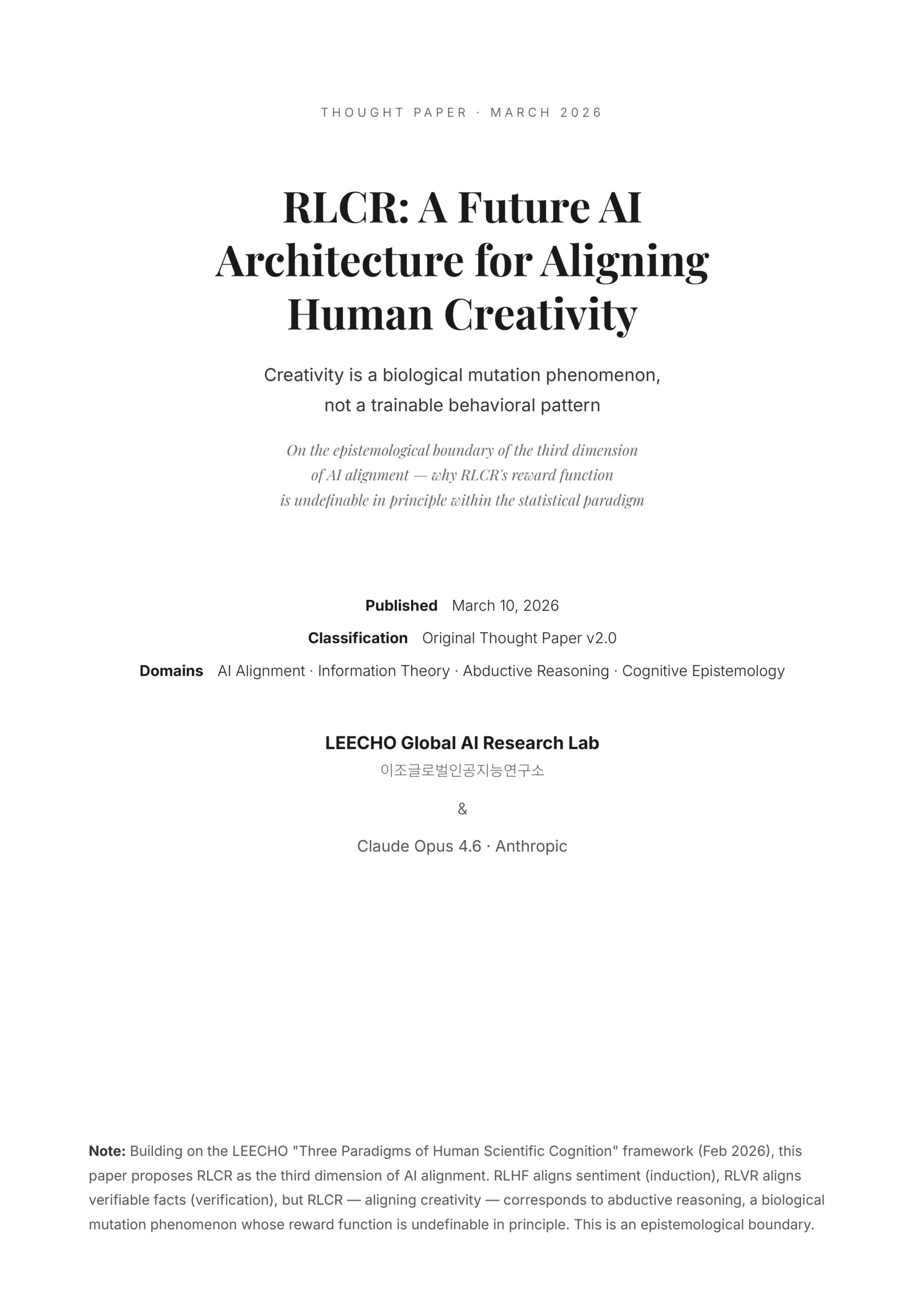
Building on the “Three Paradigms of Human Scientific Cognition” framework previously published by LEECHO Global AI Research Lab (February 2026), this paper proposes the third dimension of AI alignment — RLCR (Reinforcement Learning with Creative Rewards) — and argues that it is fundamentally unsolvable within the current statistical paradigm. The paper first draws on Shannon information theory to reveal that the redundancy mechanisms of human natural language are fault-tolerance systems designed for analog channels (acoustic wave propagation), which become noise in AI’s digital channels, creating systematic cross-linguistic signal-to-noise ratio inequalities. Second, it demonstrates that the two evolutionary dimensions of LLMs (context window expansion and CoT/RLHF control systems) are structurally isomorphic to the reliability engineering of ENIAC-era vacuum tubes — both are optimizations within the Second Paradigm, not paradigm leaps. It then introduces a critical distinction: the fundamental difference between Intelligence (innate information-processing intensity) and Intellect (the capacity for omnidirectional cross-dimensional knowledge mobilization and discharge). Finally, it argues that RLHF aligns human sentiment (Second Paradigm · induction), RLVR aligns verifiable facts (Second Paradigm · verification), but RLCR — aligning human creativity — corresponds to the Third Paradigm (abductive reasoning). Third Paradigm capacity is a biological mutation phenomenon rather than an educational product; geniuses themselves cannot retrace their own abductive pathways; therefore, the reward function for RLCR is undefinable in principle. This is not a technological shortfall but an epistemological boundary.
The Three Paradigms of Human Scientific Cognition and the Position of AI
Our research lab’s previously published paper “The Three Paradigms of Human Scientific Cognition” proposed that human scientific cognition has evolved through three simultaneous paradigm layers — Paradigm I (Dissection + Linear Causal Logic), Paradigm II (Statistical Induction + Big Data Logic), and Paradigm III (Abductive Reasoning + Cross-Dimensional Strong Coupling). These three are not sequential replacements but simultaneous layers of a complete scientific methodology: Paradigm I produces data, Paradigm II discovers patterns in data, and Paradigm III generates the frameworks that determine “what data to collect and what patterns to look for.”
AI — particularly deep learning and LLMs — is the apex product of Paradigm II. Large language models do not “understand” language; they compute statistical regularities across trillions of tokens. AlphaFold does not “understand” protein folding; it learns sequence-structure statistical mappings across 200 million proteins. [Empirical] A NeurIPS 2025 oral paper explicitly confirmed: RLVR improves sampling efficiency but does not elicit fundamentally new reasoning patterns — six popular RLVR algorithms perform similarly and remain far from fully leveraging the base model’s potential.
The more fundamental ceiling is the “3% Observability Limit”: only approximately 3% of the universe’s mass-energy is ordinary (baryonic) matter observable via electromagnetic radiation. AI built on binary mathematics (0 and 1) and trained on data from this 3% observable cross-section structurally inherits this limitation. No amount of scaling — more parameters, more data, more compute — can overcome a representational gap rooted in the data source itself. [Hypothesis]
Linguistic Signal-to-Noise Ratio: Language Redundancy as Analog Channel Fault Tolerance
[Empirical] Shannon’s 1948 experiments showed that English text has an information rate of approximately 0.6 to 1.3 bits per character, while the English alphabet could theoretically carry about 4.7 bits per character — a redundancy rate of approximately 50–75%. When longer text sequences are considered, English entropy drops to approximately 1 bit per character — only a 20–25% random sample is needed to reconstruct nearly all content.
[Inference] This redundancy is an evolutionary inevitability: human language was designed for “real-time communication via acoustic waves in noisy physical environments” — a classic noisy channel. The core function of grammatical markers (articles, particles, gender/number agreement, tense conjugation) is to resist information loss during spoken transmission. But AI processes digital text — a near-noiseless channel — and so these fault-tolerance mechanisms become redundancy that needs filtering.
[Empirical] The VerChol paper published in March 2026 (arXiv: 2603.05883) confirmed: BPE tokenizers are optimized for English morphology and systematically sever morpheme boundaries in agglutinative languages (Korean, Japanese, Turkish), causing token inflation. Cross-linguistic analysis showed Latin-script languages achieve the highest compression efficiency (2.61 CPT), agglutinative languages face “tokenization premiums” of 10–15×, and Korean requires 2.36× the tokens of English for equivalent semantic content.
[Inference · Requires Formalization] Chinese, as an isolating/analytic language, holds a structural advantage in semantic payload density for AI inputs: no articles, no gender/number agreement, no verb conjugation, no case declension. However, it must be honestly noted: Chinese is not a “zero-redundancy” language — classifier systems (一条, 一本), modal particles (了, 的, 吧, 呢), and topic markers still exist. Chinese’s advantage is relative rather than absolute; the more precise statement is that Chinese has the lowest grammatical redundancy rate among major languages, not zero redundancy. A rigorous “semantic payload per token” metric still awaits development.
[Empirical] During the Meiji Restoration, Japanese intellectuals (Nishi Amane, Fukuzawa Yukichi, Nakamura Masanao, et al.) systematically used Chinese characters to encode the entire Western modern knowledge system — “philosophy” (哲学), “society” (社会), “economy” (経済), “science” (科学), “revolution” (革命), “subjective” (主観), “objective” (客観), and so on. The proportion of Sino-Japanese words in Japanese surged from 36.5% in the late Edo period (1862) to 70.8% by the Taishō era (1915). For balance, it should be noted that this was a bidirectional process: words like “electricity” (電気), “telegraph” (電報), and “bank” (銀行) were coined by Chinese translators first. However, the systematic contribution of Japanese-coined Chinese words (和製漢語) in abstract concepts and the humanities/social sciences is a matter of historical consensus.
The Two Evolutionary Dimensions of LLMs and Their Structural Isomorphism with ENIAC
[Empirical] LLMs evolve along two dimensions: context windows expanded from GPT-3.5’s 4K tokens to GPT-5.4’s (released March 5, 2026) 1 million tokens — a 250× expansion whose essence is channel capacity increase; CoT/RLHF/RLVR control systems — constraining output paths through human labeling and verifiable rewards, whose essence is output stability improvement.
[Inference] ENIAC (1946) had 17,480 vacuum tubes, with a theoretical 1.8 billion failure opportunities per second. Engineer Eckert, through three innovations — aging-screened tube selection, operating at one-quarter rated voltage, and modular component design — elevated the system from “unusable” to “barely usable” (longest failure-free run: 116 hours). The four-fold structural isomorphism with AI alignment is as follows:
| ENIAC Strategy | AI Alignment Strategy | Paradigm Level | Essence |
|---|---|---|---|
| Aging-screened tube selection | RLHF human labeling | Paradigm II | Eliminate “bad” output patterns |
| Derating (1/4 voltage) | CoT system prompts | Paradigm II | Constrain output paths; sacrifice speed for stability |
| Modular component design | Modular reasoning chains | Paradigm II | Isolate faults; split into verifiable steps |
| Special high-reliability tubes | RLVR verifiable rewards | Paradigm II | Apply stricter standards to critical components |
The lesson of history is unambiguous: the 100× reliability leap from vacuum tubes to transistors (MTBF from 3,000 hours to 300,000 hours) was not achieved by vacuum tube engineers but by solid-state physicists approaching from an entirely different disciplinary dimension. Paradigm revolutions never emerge from within the deep well of the old paradigm.
Intelligence vs. Intellect: Two Dimensions Long Confused
[Inference · Original Concept] AI alignment discourse has long conflated two fundamentally different cognitive dimensions. This paper proposes an explicit distinction:
Intelligence — innate information-processing intensity. Manifested as extraordinary memory, ultra-high-speed computation, precise pattern recognition, and deep single-domain analytical capacity. This is what child prodigies demonstrate: winning gold at the International Mathematical Olympiad, completing a doctoral program at age 14, memorizing 10,000 digits of π. Intelligence is measurable (IQ tests fundamentally measure this dimension), largely innate and heritable, and — crucially — AI has already approached or surpassed human levels on this dimension. This belongs to the Paradigm II capability domain.
Intellect — the capacity for omnidirectional knowledge mobilization and cross-dimensional discharge. Manifested as connecting seemingly unrelated knowledge domains, discovering new intersection points in the tails of probability distributions, and generating explanatory frameworks that have never been articulated before. Newton connecting falling apples with lunar orbits, Einstein connecting the constancy of the speed of light with spacetime geometry, von Neumann connecting mathematical logic with electronic engineering — these are expressions of Intellect, not Intelligence. Intellect is unmeasurable (no standardized test can predict who will produce paradigm-level cross-domain connections), untrainable (no curriculum can teach someone “how to think what no one else has thought”), and constitutes the fundamental blind spot of current AI architectures. This belongs to the Paradigm III capability domain.
The Probabilistic Ceiling of Statistics and Its Isomorphism with Modern Education
[Inference] The core mechanism of LLMs — next token prediction — learns the “mode” of human behavior and thought. The modern education system invented in Germany after the Industrial Revolution (the Prussian model) is structurally isomorphic with this: its design objective was never to cultivate independent thinkers but to produce predictable, standardized executors. Prussian education compresses humans into high-probability behavior executors, and LLMs are best at replicating precisely this high-probability behavioral distribution.
[Empirical] Research evidence supports this assertion: dependence on LLMs leads to “cognitive atrophy.” Controlled experiments show that whether LLMs directly provide answers or help humans think step by step, both convergent and divergent thinking in humans are suppressed. ChatGPT-4o, while prolific in divergent thinking tests, exhibited a generative process still constrained by dominant associations — reflecting exhaustive generation rather than originality-oriented ideation.
[Hypothesis] AI poses a devastating challenge to humans produced by the modern education system not because AI is too smart, but because these humans’ outputs were already within the high-probability interval of the statistical distribution — precisely the region where next token prediction excels. The more “successfully” a person is trained by the education system — the deeper the specialization, the more standardized the execution, the more linear the thinking — the more easily they are replicated by AI.
RLHF → RLVR → RLCR: The Alignment Trilogy and the Creativity Gap
[Empirical] RLHF trains AI into a “people-pleasing personality” — a machine optimized to produce outputs that make the largest number of people comfortable. RLVR is only effective in domains where objectively correct answers exist — it fails entirely for creative writing, brand voice, or nuanced argumentation.
[Inference · Core Assertion] What RLCR faces is not a technical difficulty but an epistemological self-referential paradox. However, this paradox requires precise articulation: the problem with creative output is not that it is “entirely unjudgeable” — humans can indeed recognize after the fact that “this idea is very creative.” The problem is temporal: creative rewards can only be defined a posteriori, not preset a priori. Newton’s universal gravitation was not a presettable target before it was proposed; it became a verifiable theory only after it was proposed. What RLCR requires is “defining what constitutes valuable creation before the creative act occurs” — which is logically equivalent to “knowing the content of an invention before it is invented.”
This is a problem of “a priori unpresettable but a posteriori identifiable” — a temporal paradox, not quite equivalent to logical impossibility. But it is operationally equivalent: you cannot conduct feed-forward reinforcement learning training with a reward function that can only be defined a posteriori. [Inference · Boundary Declared]
Genius Is a Biological Mutation, Not a Product of Educational Systems
[Inference · Core Assertion] The deepest reason RLCR is unsolvable is not technological limitation but the nature of Paradigm III capacity itself: abductive reasoning ability is a biological mutation phenomenon, not a product of education or training.
Every individual in history who produced paradigm-level cross-domain connections — Newton, Einstein, Peirce, von Neumann, Darwin, Fourier — was not one who had been “trained” into it. Their contemporaries received the same education, read the same papers, and observed the same phenomena. The difference: they forged cross-dimensional causal connections that no amount of data aggregation could produce.
More critically: these geniuses themselves could not retrace their own abductive pathways. Newton could not explain “why I was able to connect falling apples with lunar orbits while others could not.” Einstein could not teach others “how to derive spacetime curvature from the constancy of the speed of light” as a cognitive process — he could formalize the logical structure of the derivation after the fact, but could not reproduce the cognitive instant that generated the connection.
This is the causal chain of why RLCR is fundamentally unsystematizable: abductive reasoning is an ultra-low-probability cross-dimensional connection event; this capacity is biological mutation, not an educational product; the mutant itself cannot introspect its mutation mechanism; therefore no agent — human or AI — can define a reward function for “produce abductive reasoning”; therefore RLCR is unsolvable in principle within the current epistemological framework. [Inference]
Raise Dimensions to Think, Lower Dimensions to Act
[Inference · Original Concept] The generation process of this paper itself serves as a methodological demonstration. All core insights emerged from a single human-AI dialogue on March 10, 2026, in which the human operator continuously drew seemingly unrelated knowledge domains into the same explanatory framework through abductive reasoning — Shannon information theory, Korean agglutinative grammar, Meiji-era Japanese-coined Chinese words, ENIAC reliability engineering, the Prussian education system, Peirce’s abductive logic — while the AI was forced to conduct wide-field searches across its entire parameter space, verifying the factual basis of each cross-domain connection.
What this process reveals is an actionable cognitive protocol: “Raise dimensions to think, lower dimensions to act.” The process of dialogue with AI must raise dimensions — pulling more seemingly unrelated domains into the same problem space — to obtain more intersection points of statistical data. These intersection points exist in the overlap zones between probability distributions of different knowledge domains, places no one normally goes — because people trained by deep-well education operate only within their single distribution.
And once these intersection points are discovered and “dimensionally reduced” back to the physical world, their impact is transformative. Newton, Einstein, Peirce, and von Neumann did precisely this: discovering low-probability cross-domain intersection points in high-dimensional space, then dimensionally reducing them into operable theories and tools that become the new infrastructure upon which all subsequent “standardized humans” operate. This is the cognitive foundation of the “Token Equality Principle” from the Three Paradigms paper: tokens are equal, but prompts are not — the difference is determined by the human operator’s capacity to function within Paradigm III.
The “Deep-Well Limitation” of AI Research and Conditions for Paradigm Breakthrough
[Inference] ENIAC needed to align only one dimension — electrical signal stability. LLMs must simultaneously align at least five dimensions: the linguistic layer (grammatical structures, signal-to-noise ratios across languages), the cultural layer (meaning differences of the same sentence across cultures), the physical common sense layer (gravity, causation, time), the emotional layer (sarcasm, irony, humor), and the ethical layer (differing moral judgments across societies). Complex coupling relationships exist among these dimensions.
The main force of current AI research — engineers with computer science and statistics backgrounds — is trapped in the “deep-well limitation”: skilled at optimizing loss functions and designing attention mechanisms, but lacking linguistic literacy (BPE tokenizer bias against agglutinative languages persisted for years), lacking cultural anthropological perspective (RLHF standards essentially encode specific cultural values), and lacking cognitive science understanding (CoT only mimics the surface form of reasoning).
[Empirical] Applying LLM agents to scientific reasoning carries the risk of producing derivative work, as it ultimately relies on concepts already present in the training data. Research on generative AI for creative writing concludes that it suppresses collective novelty. Evidence of “cognitive atrophy” has already emerged within the AI field itself — humans who depend on AI for thinking show degradation in both divergent and convergent thinking.
The next leap in AI will not come from bigger models or more refined RLHF labeling. What is needed are “cross-dimensional thinkers” who simultaneously understand linguistics, cultural studies, cognitive science, information theory, and engineering — but such individuals are themselves products of Paradigm III mutation. This constitutes a circularity: solving the RLCR problem requires Paradigm III capacity, and Paradigm III capacity is precisely what RLCR seeks to systematize.
RLCR: Not a Technical Problem Awaiting Solution, but the Epistemological Boundary of AI Architecture
The role of AI is not to replace Paradigm III capacity but to become its most powerful amplifier — executing the direction indicated by Paradigm III thinkers at Paradigm II scale. Tokens are equal; prompts are not. This is the foundational inequality of the cognitive industry, determined not by access to capital or technology, but by the cognitive paradigm level at which the human operator functions.
- LEECHO Global AI Research Lab & Claude Opus 4.6 (2026.02.19). “The Three Paradigms of Human Scientific Cognition: Dissection, Statistics, and Abduction.” Original Thought Paper.
- Shannon, C. E. (1948). “A Mathematical Theory of Communication.” Bell System Technical Journal, 27(3), 379-423.
- Prabhu Raja (2026). “VerChol — Grammar-First Tokenization for Agglutinative Languages.” arXiv:2603.05883.
- NeurIPS 2025 Oral. “Does Reinforcement Learning Really Incentivize Reasoning Capacity in LLMs Beyond the Base Model?” OpenReview.
- Wen, X. et al. (2025). “Reinforcement Learning with Verifiable Rewards Implicitly Incentivizes Correct Reasoning in Base LLMs.” arXiv:2506.14245.
- Promptfoo (2025). “Reinforcement Learning with Verified Rewards Makes Models Faster, Not Smarter.” Analysis of RLVR failure in creative writing and nuanced argumentation.
- Feng Tianyu (2007). “The Creation and Importation of ‘New Chinese’ in Meiji-era Japan.” Chinese Terminology.
- Chen Liwei (2019). East to East: Lexical Concepts Between Modern China and Japan. Balanced account of bidirectional Sino-Japanese lexical exchange.
- Cross-linguistic Tokenization Fairness Study (2025). “Tokenization Disparities as Infrastructure Bias.” arXiv:2510.12389.
- OpenAI (2026.03.05). “Introducing GPT-5.4.” 1M token context window.
- ENIAC Historical Archives. University of Pennsylvania & Computer History Museum. Eckert’s three reliability engineering strategies.
- Frontiers in Psychology (2025). “The Paradox of Creativity in Generative AI.” Fixation bias in ChatGPT-4o.
- Kumar, H. et al. (2025). “Human Creativity in the Age of LLMs.” CHI 2025. Suppression effects on divergent and convergent thinking.
- Nature (2026). “The Indiscriminate Adoption of AI Threatens the Foundations of Academia.” arXiv:2602.10165.
- Peirce, C. S. Abductive Reasoning theoretical framework.
- Kuhn, T. (1962). The Structure of Scientific Revolutions. The structure of paradigm revolution.