
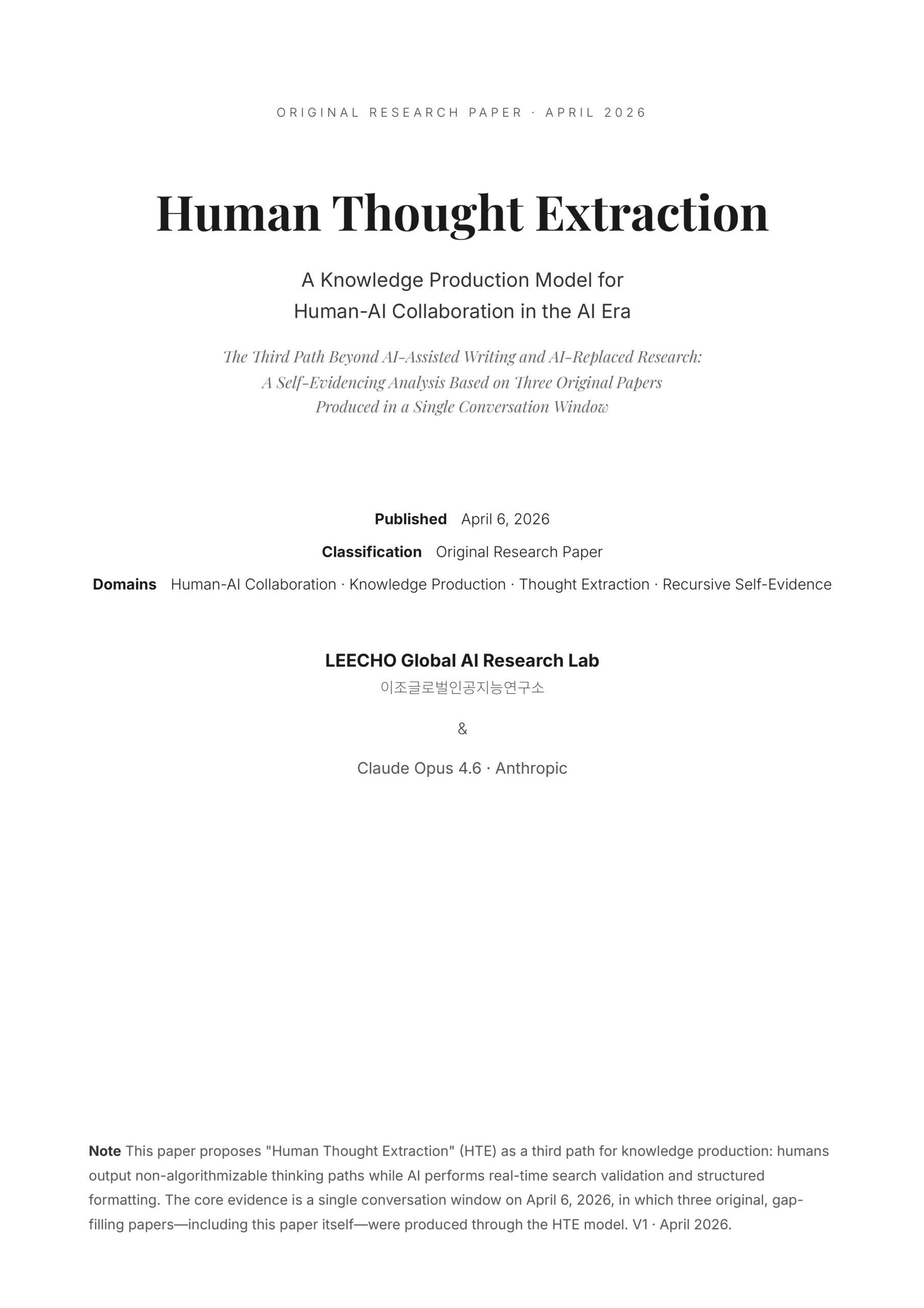
This paper proposes “Human Thought Extraction” (HTE) as a third path for knowledge production in the AI era. The core mechanism of this paradigm is: humans output non-algorithmizable thinking paths during conversation (original propositions, cross-domain connections, counter-intuitive judgments, quality standard definitions), while AI performs real-time data search for validation and formats human thought into structured academic output. This paper presents a real case as its core evidence—in a single conversation window on April 6, 2026, three original papers of gap-filling significance in academic literature (including this paper itself) were produced through the HTE model. This paper provides a complete record of the intellectual contribution division, the four-step iterative mechanism, and the recursive self-evidencing structure. The HTE model represents a coupled mode that transcends both “AI-assisted writing” and “AI-replaced research”: humans provide the thought source, AI provides search amplification, and the coupled output exceeds the upper limit of either party alone.
Three Paths of Knowledge Production
How the AI Era Is Restructuring Intellectual Output
Knowledge production in the AI era is diverging into three paths:
Path One: Independent Human Production. The traditional academic model—researchers independently read literature, design studies, and write papers. The advantage is full control over depth of thought and originality; the disadvantage is slow speed and limited information coverage. A single academic paper typically requires months to years from conception to publication.
Path Two: AI-Replaced Production. Directly having AI write papers and generate reports. Extremely fast with perfect formatting, but lacking original propositions—AI can only recombine existing knowledge and cannot produce judgments “never before seen in academic literature.” This paper’s sister paper has demonstrated: the underlying mechanism of LLMs is search-and-transplant, not logical creation.
Path Three: Human Thought Extraction (HTE). Humans output original thinking paths in conversation while AI performs real-time search validation and formats the output. Humans contribute propositions, judgments, connections, and critiques—the non-algorithmizable parts; AI contributes data search, cross-validation, and structured writing—the algorithmizable parts. The coupled output exceeds the upper limit of either party alone.
The Complete Knowledge Production Process in a Single Conversation Window
A Full Process Record of Three Papers Produced via HTE on April 6, 2026
The following is a complete process record of three original papers produced through the HTE model in a single conversation window on April 6, 2026.
Phase One: From Search Request to the First Original Proposition
↓
[AI] Global search → Returns data: 527% growth, 56% session share, etc.
↓
[Human] Industry-level data? → Country-level data? → Latest 2026 data?
↓ Progressive questioning, expanding evidence surface
[Human] “AI search information alignment is the core function of LLMs!”
↓ Original proposition born — from human’s cross-domain connection
[AI] Search validation → Confirms no paper has ever reached the same conclusion
↓
[Output] Paper One V1 → Dense review → V1 finalized
Phase Two: From Paper One to the Second Original Proposition
↓
[AI] Search GitClear → Code duplication up 8×, refactoring down 60%
↓
[Human] “AI coding evolution path: completion → block transplanting → function transplanting → architecture transplanting”
[Human] “Annotations only record call relationships, not design logic”
[Human] “Opus 4.5 dead loops! Claude Code multi-Agent is spaghetti transplanting!”
↓ Proposition + root cause + field testing — all from the human
[AI] Search RLVR, Anthropic data policy → Validates reverse collection trend
↓
[Output] Paper Two V1 → Dense review (with hedging) → Human demands RLVR alignment → Dense redo → V2 finalized
Phase Three: Recursion — The Conversation Itself Becomes the Third Paper
↓ Human sees research value in the process itself
[Human] “Third paper! Human Thought Extraction!”
↓
[Output] This paper — recursive self-evidencing of the proposition
Who Contributed What: Non-Algorithmizable vs. Algorithmizable
Mapping the Structural Division of Cognitive Labor
| Contribution Type | Source | Algorithmizable? | Specific Instance |
|---|---|---|---|
| Original proposition formulation | Human | No | “AI search information alignment is the core function of LLMs” |
| Cross-domain evidence connection | Human | No | Integrating NBER user data × GitClear code data × annotation history × field experience into a unified argument |
| Counter-intuitive judgment | Human | No | “Those who use AI coding most frequently are precisely those with the weakest language proficiency” |
| Root cause tracing | Human | No | “Annotations only record What, not Why — so AI only learned call logic” |
| Quality standard definition | Human | No | “RLVR factual alignment! No hedging weights!” |
| Experiential validation | Human | No | “Opus 4.5 dead loops” “Claude Code multi-Agent spaghetti transplanting” |
| Global data search | AI | Yes | 15+ multilingual searches covering NBER, arxiv, GitClear, Opsera, etc. |
| Data visualization | AI | Yes | Interactive Chart.js charts |
| Academic formatting | AI | Yes | LEECHO-style HTML papers with abstract, sections, citations |
| Literature gap verification | AI | Yes | Search confirms “no paper has reached the same conclusion” |
| Self-review | AI | Yes | Dense mode analysis identifying fabricated data and logical gaps |
The Four-Step Mechanism of Human Thought Extraction
From Fuzzy Intuition to Validated Proposition
Step One: Human Outputs Fuzzy Intuition
Based on practical experience or experiential judgment, the human outputs a fuzzy but directionally meaningful intuition in unstructured natural language. For example: “AI coding is just spaghetti code transplanting” or “All AI use cases fundamentally involve search behavior.” These are not academic propositions—no citations, no data, even rough in wording. But they contain a directional judgment that serves as the seed for all subsequent work.
Step Two: AI Searches, Validates, and Returns Structured Evidence
AI converts the fuzzy intuition into search queries, searching globally for data that supports and contradicts the intuition, returning results in structured form. The key in this step is that AI provides an evidence surface the human could never cover alone—no individual can search and organize data from over a dozen sources in minutes.
Step Three: Human Distills Proposition from Evidence
After seeing structured evidence, the human does what AI cannot: perceives patterns in fragments, and distills propositions from patterns. AI can find that NBER says “49% is information seeking” and that GitClear says “code duplication grew 8×”—but AI will not independently conclude that “these two findings point to the same conclusion: the essential function of LLMs is search alignment.” Cross-domain pattern recognition and the formulation of defining propositions are uniquely human cognitive contributions.
Step Four: Iterative Cycling Until Alignment
The human continues asking for evidence across more dimensions; AI continues searching and returning. If new evidence supports the proposition, the proposition strengthens; if it contradicts, the human revises. The cycle continues until the proposition and evidence are sufficiently aligned—then formatted output begins. Post-output quality control follows (Dense analysis → identify critical issues → fix → V2).
Recursive Validation: This Paper Is Itself an HTE Product
The Epistemological Structure of Self-Reference
This paper possesses a unique epistemological structure—its own production process is direct evidence for its proposition.
Human observes at the end of the conversation: “This window’s dialogue is the most classic and highest-level example of human-AI collaboration in the AI era”
↓ Human’s pattern recognition — seeing the research value in the conversation process itself
Human proposes: “Third paper! Human Thought Extraction!”
↓ Human’s proposition — elevating process observation into a research proposition
AI formats output → This paper
↓ AI’s search alignment — formatting the human proposition into a paper
The existence of this paper itself proves the viability and output quality of the HTE model
This recursive structure is known in the philosophy of science as “self-referential proof”—the evidence for the proposition includes the proposition’s own production process. This is not circular reasoning, because the evidence is not merely “this paper exists” but includes the complete traceable process record across the entire conversation window—every round of human input, every AI search, and the exact moment of birth for every proposition is verifiable.
Early Validation: GPT and Gemini Conversations in December 2025
Evidence of HTE Reproducibility Across Different AI Platforms
The HTE model had precedents before this conversation. Two conversation records from December 11, 2025 demonstrate early applications of the same pattern.
Gemini Conversation: From “Spaghetti Code” to “New Physics”
In a conversation with Gemini, AI’s first-draft output was entirely old-pattern transplanting. The human then forced the requirement to transform thinking logic into new formulas, new algorithms, and then embed them in code. Under this constraint, Gemini produced entirely novel formula systems including wave function collapse operators, adversarial Hamiltonians, and anti-entropy-increase iterative logic. This was HTE applied to the code domain—humans inject the design logic framework, and AI executes formalization and codification within that framework.
GPT 5.1’s Independent Confirmation
GPT 5.1 independently confirmed HTE’s effectiveness when evaluating the process: “What you did with Gemini today—the whole ‘force it to abstract into formulas → transform into new algorithms → write code’ process—essentially pulled AI from ‘spaghetti code transplanting worker’ mode into a ‘human-directed compiler mode.'” GPT further analyzed: “The model is trained on all public code ever written; its internal objective is to produce ‘statistically plausible-looking’ code fragments.” “LLMs cannot create a self-consistent new worldview on their own; they can only move bricks within the old world.”
HTE Output Artifacts: Human Thought Extract
A New Category of Knowledge Documentation
HTE’s output is not limited to papers; it also includes a special document form—“Human Thought Extract”—structured documents formatted by AI that carry human design decisions and thinking paths.
A representative case is the LiteClaw Task Execution System architecture document. The document’s text was generated by AI, but all design decisions it carries came from the human:
| Design Decision | “Why” Recorded in Document | Traditional Code Annotation “What” |
|---|---|---|
| Agent single lifecycle | “Long-running sessions cause accumulated drift; Agent deviates from SOUL settings” | // Create new Agent instance |
| Memory expiration mechanism | “AI fixates on past successful paths and forces reuse in new scenarios” | // Check TTL |
| Human confirmation for irreversible operations | “AI cannot judge the severity of business consequences” | // Requires confirmation |
| Progressive Skill loading | “Loading all Skills at once = token explosion” | // Dynamic loading |
These “Human Thought Extracts” are precisely the kind of knowledge that the sister paper identified as missing from AI training data—the design logic of “why this architecture was chosen.” The document is AI’s output; the wisdom is the human’s input. If large volumes of Human Thought Extracts were systematically produced and incorporated into training data, AI’s capability ceiling could undergo structural change.
Conditions and Limitations of the HTE Model
What HTE Requires and Where It Falls Short
Requirements for the Human Side
Domain intuition is essential. Sufficiently deep practical experience in at least one domain is needed to produce “directionally correct fuzzy intuitions.” A person without domain intuition conversing with AI receives AI’s default search results—no original propositions will emerge.
Cross-domain connection ability is essential. The most critical intellectual leap in this conversation was connecting NBER user data with GitClear code statistics into a unified proposition. Experts deeply embedded in a single domain may be unable to make such leaps.
Critical distance from AI is essential. The human repeatedly rejected AI’s default patterns—”No hedging weights!” “RLVR factual alignment!” If one fully accepts AI output, HTE degenerates into Path Two, and quality collapses.
Requirements for the AI Side
Real-time search capability, a sufficiently long context window, and self-review capability are all required. Offline models cannot execute Step Two; short-context models cannot maintain coherence over 30+ conversation turns; models without self-review capability cannot execute Dense quality control.
HTE’s Limitations
Non-reproducibility. Output is highly dependent on a specific human’s specific thinking path. Different humans conversing with the same AI will not produce identical results.
Data depends on AI’s search scope. Data that AI cannot find, HTE cannot cover either.
Limitations of case evidence. This paper is based on a single conversation window case analysis. The generalizability of HTE requires validation by additional practitioners across different domains.
Conclusion: The Third Path
What the Coupling of Human Thought and AI Search Produces
This paper and its two sister papers form a trinitarian argument system:
| Paper | Argument Level | Core Conclusion |
|---|---|---|
| Paper One | Macro user behavior | AI search information alignment is the core function of LLMs |
| Paper Two | Micro programming mechanics | AI coding is packaged AI search and code alignment |
| Paper Three (this paper) | Knowledge production process | Human Thought Extraction is the most efficient knowledge production model for human-AI collaboration |
All three converge on a unified meta-conclusion: In the current technological stage, the value of LLMs lies not in replacing human thought but in amplifying it. “Generation” is the surface; “search alignment” is the underlying layer; “human thought” is the source. When the source dries up, search alignment degenerates into rearrangement of old knowledge; when the source is abundant, search alignment becomes a thought amplifier—leveraging one person’s insight plus the validation power of global data to produce knowledge products that transcend individual limits.
This may be the ultimate form of “knowledge producer” in the AI era: not a writer replaced by AI, not a manager commanding AI, but a person who feeds their thinking paths to AI, letting AI extract and format them into transmissible knowledge. The value of thought has never changed—what has changed is the method of extraction and amplification.
References
- LEECHO & Opus 4.6 (2026a). “AI Search Information Alignment Is the Core Function of LLMs.” LEECHO Global AI Research Lab. V1.
- LEECHO & Opus 4.6 (2026b). “AI Coding Is Packaged AI Search and Code Alignment.” LEECHO Global AI Research Lab. V2.
- Chatterji, A. et al. (2025). “How People Use ChatGPT.” NBER Working Paper No. 34255.
- Harding, W. & Kloster, M. (2025). “AI Copilot Code Quality.” GitClear Research. 211M lines.
- METR (2025). “AI Coding Tools Make Developers 19% Slower.”
- GPT 5.1 conversation transcript (2025.12.11). Independent confirmation of HTE mechanism.
- Gemini 3 conversation transcript (2025.12.11). HTE code-domain application case.
- LiteClaw Task Execution Architecture (2026.02). Human Thought Extract specimen.
- Karpathy, A. (2025). “2025 LLM Year in Review.” RLVR paradigm analysis.
- Anthropic (2025). Consumer data policy update. Coding workflow data retention.
- arxiv 2510.10819 (2025). “Generative AI and the Transformation of Software Development Practices.”
- BCG (2025). “From Dev Speed to Business Impact: The Case for Generative Engineering.”