
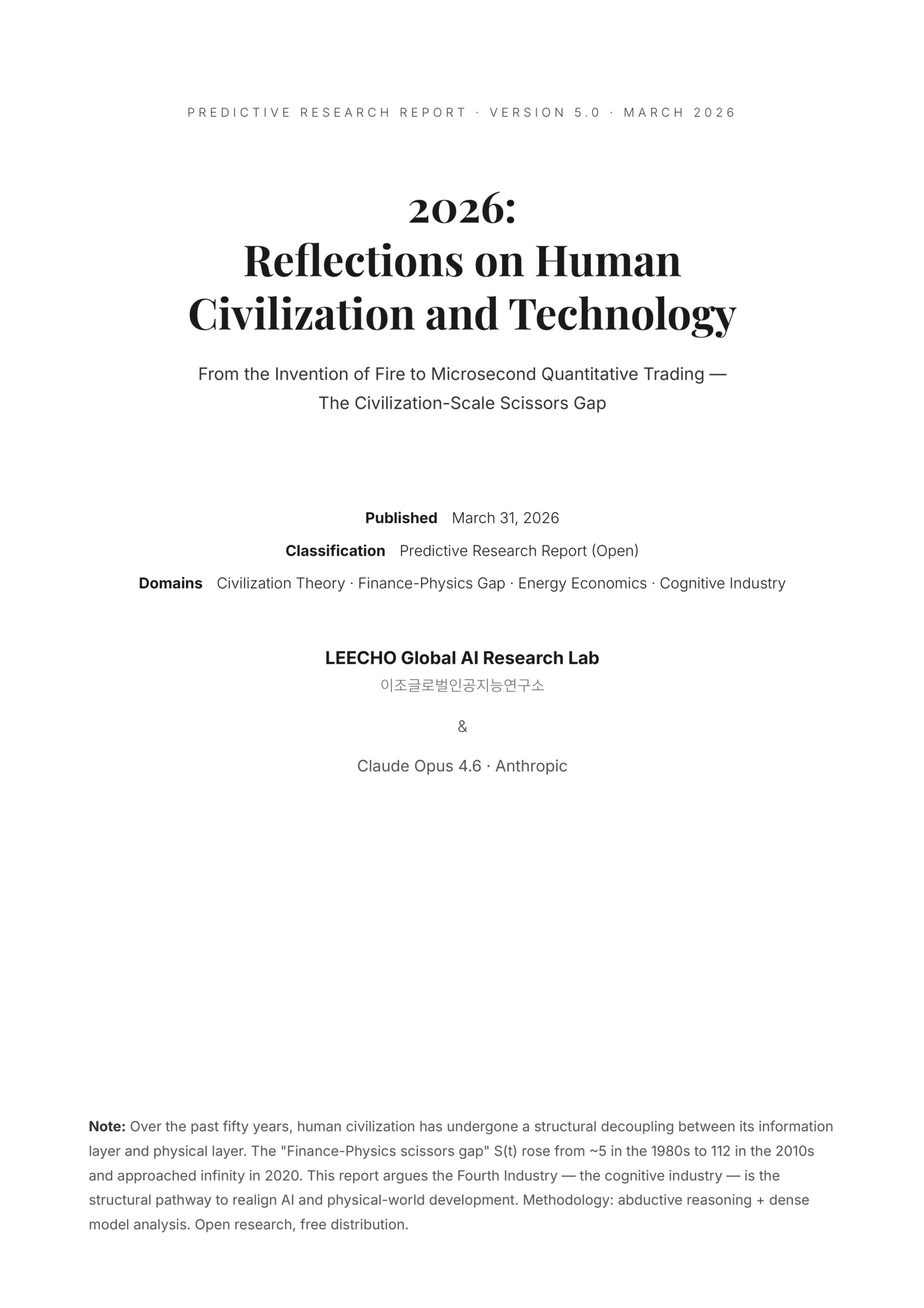
Human civilization has evolved from the invention of fire along two intertwined threads: the technological evolution of transforming the physical world, and the history of recording and transmitting information. Through abductive reasoning—starting from observed anomalies (extreme information-layer prosperity alongside physical-layer stagnation; a widening ratio of incremental financial assets to incremental energy consumption)—this report argues a central thesis: over the past fifty years, human civilization has undergone a structural decoupling between its information layer and physical layer. We define the “Finance-Physics scissors gap” as S(t), the ratio of annual incremental global financial assets to the annual incremental economic value of energy consumption. S(t) rose from ~5 in the 1980s to 112 in the 2010s and approached infinity in 2020. The 2024 apparent decline to 29 is a statistical illusion—the coincidental synchronization of the Fed’s rate peak suppressing the numerator with AI infrastructure expansion inflating the denominator—not structural repair. The Fourth Industry—the cognitive industry—is the structural pathway to realign AI and physical-world development.
Methodology: Abductive Reasoning + Dense Model Analysis · Classification: Open Research · Free Distribution
Abductive Reasoning: From Anomaly to Explanation
Abductive Reasoning: From Anomaly to Explanation
This report’s reasoning is neither confirmation bias nor deductive reasoning from axioms. It is abductive reasoning—starting from observed anomalies, reverse-engineering the most probable deep causes, verifying or correcting hypotheses with data, progressively narrowing the explanatory space.
The reasoning chain:
Anomaly ①: Humans perceive “rapid progress,” yet aircraft speeds unchanged for 60 years, energy mix for 70, fundamental physics for 50. Progress only in the information layer. → Inference: Information-layer prosperity masks physical-layer stagnation.
Anomaly ②: The brightest young people flood into software and finance, abandoning materials science and energy physics. → Inference: Salary signals have distorted talent allocation—a systemic pricing failure.
Anomaly ③: Global financial assets grew 142× since 1980, energy consumption only 2.2×. → Inference: The financial system is self-inflating in detachment from the physical world.
Anomaly ④: Federal basic R&D fell from 1.86% to 0.63% of GDP; quantitative trading operates in microseconds. → Inference: Investment cycle collapse causes systematic hemorrhaging of basic science.
Convergence: All anomalies point to the same structural problem—decoupling of financial from physical layers. The solution must restore economic value to physical-world action. → The Fourth Industry framework.
Fire: Humanity’s First technology and Hardware Upgrade
The First technology and the Biological Hardware Upgrade
Fire was humanity’s first true “technology.” Harvard primatologist Richard Wrangham’s “cooking hypothesis” proposes that cooked food dramatically reduced digestive costs, releasing energy reallocated to the brain. The human brain comprises ~2% of body weight yet consumes ~20% of total energy. Fossil records show Homo erectus tooth and digestive tract reduction coincided with brain volume expansion.
The “cooking hypothesis,” while compelling, is not settled science. A 2016 PMC study showed large-scale primate brain growth occurred millions of years before widespread fire control. More accurately: cooked food was very likely an important driver of continued brain expansion, but not the sole factor.
Fire brought more than a biological hardware upgrade. The hearth became the earliest social center—communal eating, language exchange, and storytelling formed the prototype of tribes, cultures, and beliefs. Fire was humanity’s first act of harnessing a natural force as a tool, launching the thread of “energy mastery” running through all technological history.
Every subsequent human invention essentially repeated externally what fire once did for the body—using external tools to upgrade inherent capabilities. Stone tools extended the hand, language extended memory, writing extended time, computers extended the brain.
Information Recording and Dissemination: The Invisible Spine of Civilization
Information Recording and Dissemination: The Invisible Spine of Civilization
If energy mastery is the visible thread of technological history, then information recording and transmission is civilization’s most critical hidden thread. The upper bound of civilizational scale in every era was determined by its information technology. Oral language supported tribes, writing supported city-states and empires, printing supported nation-states, the internet supported globalization, and AI may support an organizational form we don’t yet have a name for.
The Unpredictability of Technological Evolution and Paradigm Shifts
Unpredictable Breakthroughs and Paradigm Shifts
The essence of technological breakthrough is emergence, not planning. True progress is paradigm shift—the framework itself gets replaced. Every paradigm shift is the discovery of a deeper abstraction.
| technology | Paradigm Essence | Impact |
|---|---|---|
| The Wheel | Turned friction from enemy into manageable variable | Redefined distance, trade, warfare |
| Paper | Information carrier cost reduced by 1-2 orders of magnitude | What wasn’t worth recording suddenly was |
| Printing | Eliminated the profession of copying itself | Fundamentally altered information flow |
| Binary Computing | All information unified into discrete logic | Foundation of the digital age |
| Hard Disk (Random Access) | From sequential to instant access | Fundamentally changed human-information interaction |
Breakthroughs are random, but diffusion follows patterns; invention depends on luck, adoption on institutions. Civilizational competitive advantage lies not in producing geniuses, but in making their achievements flow rapidly.
The Current State of Civilization’s Longest and Shortest Staves
The Current State of Civilization’s Longest and Shortest Staves
Longest staves: Information & computing, communications, semiconductor design—far outpacing all other capabilities.
Shortest staves:
(1.86% in 1964)
energy, storage, biomedical, education, institutional governance—five critical shortcomings. The longest stave (information & computing) has far outgrown the others, while the shortest are becoming civilization-level bottlenecks.
First shortcoming: energy. The most critical. AI data center energy consumption is growing exponentially, but generation and transmission infrastructure expands linearly. Grid queues, 2-3 year transformer delivery, 5-10 year plant permitting. Fusion has moved to verification—China’s EAST broke plasma density limits, SPARC expected 2026—but commercialization remains 10-15 years away. energy is the master bottleneck.
Second shortcoming: energy storage. Even clean energy can’t be stored. Sodium-ion batteries have reached ~175 Wh/kg, near LFP levels, but the lab-to-scale gap remains immense. Australian scientists achieved a proof-of-concept quantum battery in March 2026, but practical use is years away. Without storage breakthroughs, renewables cannot replace fossil fuels—the sun doesn’t shine on the grid’s schedule.
The Structural Decoupling of the Information World and the Physical World
The Structural Decoupling of the Information World and the Physical World
| Domain | Current State | Stagnation |
|---|---|---|
| Aviation | Cruise speed 480-510 knots, below Boeing 707’s 525 knots in the 1960s | 60+ years |
| Construction | Reinforced concrete frames, fundamentally unchanged from 50 years ago | 50+ years |
| energy | Fossil fuels still at 86% of primary energy | 70 years |
| materials | All everyday materials matured in first half of 20th century | 80+ years |
| Space | Moon landing 1969, still working to return in 2026. Chemical rocket principles unchanged | 57 years |
Progress That Has Occurred in the Physical World
The physical world is not entirely stagnant: solar PV costs fell over 90% in a decade; mRNA achieved a paradigm breakthrough during COVID; CRISPR is entering clinical use; SpaceX reduced launch costs by an order of magnitude. These are real advances.
However, these remain insufficient to close the scissors gap. Solar is cost reduction, not energy density paradigm shift;mRNAis biological information encodingtechnology, essentiallycloser to information-layer breakthrough;SpaceXreduced costs but chemical rocket physics unchanged. No paradigm replacement in energy density, material strength, or transportation speed。
Technology is not building foundations,butexterior wallspainting graffiti。Foundation:energy、materials、manufacturing、biobiotechnology; structureStructure: infrastructure、transport、Construction;Exterior: information systems、software、internet;Graffiti: social media, short videos, avatars. For 30 years, most innovation and capital went to graffiti。
Three Centuries of Physical Science
19th century—the explosion. Three laws of thermodynamics, electromagnetic unification, periodic table, internal combustion engine and generator. Each directly transformed the physical world. Breakthroughs came at extremely high density.
20th century——deceleration。Relativity, quantum mechanics, nuclear physics were profound (nuclear power, semiconductors). After the Standard Model (1970s), no disruptive progress for fifty years。
21st century——near stagnation。Nature 613analysis of millions of papers and patents: disruptive discovery is slowing, physics and chemistry declining most。
The root cause of physical-world stagnation lies not within physics—not because nature’s laws are exhausted—but in the economic incentive structures supporting physical expansion. Capital flows, talent allocation, investment cycles—variables that seem to belong to economics—actually determine how many resources physics and chemistry receive. This leads to our core analysis: the structural decoupling of financial from physical layers.
Salary Distortion and Talent Misallocation
Salary Distortion and Talent Misallocation
| Profession | Entry (USD/yr) | Senior (USD/yr) |
|---|---|---|
| Software Engineer (FAANG) | 80,000 – 150,000 | 150,000 – 400,000+ |
| materials Science Engineer | ~93,000 | ~153,000 |
| Physics Engineer | ~53,000 | ~73,000 |
| Chemist | ~60,000 | ~112,000 |
Only 1 in 7 physics bachelor’s graduates pursue a physics doctorate. Employment growth projections to 2034: physicists +4%, chemical engineers +3%, information security analysts +29%.
The human brain evolved for physical-world survival. But information technology created a purely mental world where the body became a mere container. The unprecedented mismatch between sedentary cognition and active physicality produces biological backlash: sedentary lifestyles, obesity, metabolic disease, and mental health crises.
The Finance-Physics scissors gap: Definition, Formula, and Historical Data
The Finance-Physics scissors gap: Definition, Formula, and Historical Data
ΔE$(t) = Annual increase in economic value of global energy consumption (USD)
S(t) → 1 indicates alignment | S(t) >> 1 indicates financial detachment from physical layer
Why energy as the anchor? energy is the fundamental metric of all physical activity—construction, manufacturing, transportation, computation, biological maintenance. All physical change reduces to energy conversion. Financial wealth can be created from nothing (derivatives, leverage, credit), but energy cannot. A kilowatt-hour is a kilowatt-hour. No leverage applies.
Calculating ΔE$(t)
ΔE$(t) = Annual increase in primary energy consumption (EJ) × global energy weighted average price (USD/EJ). Global energy market ~$6-7T (IEA 2024), ~620-650 EJ, unit price ~$10B/EJ. If annual increment = 14 EJ, then ΔE$ ≈ $1.4T. Different methods (market price vs. marginal cost) produce 10-20% variance but do not affect order-of-magnitude conclusions.
Data Scope Note
“Global total assets” uses the McKinsey Global Balance Sheet methodology: real assets + financial assets outside the financial sector + financial sector internal assets. 2024 total: ~$1,700T ($620T real + $570T non-financial + $520T financial sector). This differs from McKinsey’s 2005 “Global Financial Stock” ($118T in 2003, equities/bonds/deposits only). We use total assets because it more completely reflects overall financial system inflation. ΔFA(t) includes both new real investment and asset price inflation—McKinsey confirms the latter is 36% (“paper wealth”), which is precisely the measure of financial churning.
Historical Data
| Year | Global Total Assets* | Energy | Avg Annual Asset Δ | Avg Annual Energy Δ | Notes |
|---|---|---|---|---|---|
| 1980 | ~12T$† | ~290 EJ | — | — | Baseline, Finance≈GDP |
| 1990 | ~200T$ | ~370 EJ | ~19T/yr | ~8 EJ/yr | Financial engineering begins |
| 2000 | ~440T$ | ~400 EJ | ~24T/yr | ~3 EJ/yr | Dot-com peak |
| 2005 | ~550T$ | ~470 EJ | ~22T/yr | ~14 EJ/yr | Subprime brewing |
| 2008 | ~500T$ | ~500 EJ | -17T(single yr) | +10 EJ/yr | Crisis, asset contraction |
| 2010 | ~600T$ | ~530 EJ | ~50T/yr | ~15 EJ/yr | QE-driven rebound |
| 2015 | ~900T$ | ~560 EJ | ~60T/yr | ~6 EJ/yr | Low-rate inflation |
| 2019 | ~1,200T$ | ~585 EJ | ~75T/yr | ~6 EJ/yr | Pre-pandemic peak |
| 2020 | ~1,540T$ | ~560 EJ | +340T(single yr) | -25 EJ(single yr) | COVID anomaly‡ |
| 2024 | ~1,700T$ | ~650 EJ | ~40T/yr | ~14 EJ/yr | AI narrative-driven |
*McKinsey Global Balance Sheet (real + financial + financial sector internal). †1980 from McKinsey 2005 narrow financial stock (~$12T); full-scope ~$50-80T, original retained for comparability. ‡2020: COVID lockdowns reduced energy ~25 EJ; QE drove single-year asset surge ~$340T.
Chart 1: Normalized Index (1980 = 100)
Chart 1: Both lines from same starting point (1980=100). Financial assets grew 142× while energy grew only 2.2×. energy line nearly flat at this scale—the scissors gap made visible.
Chart 2: S(t) scissors gap Index Time Series
Chart 2: S(t) from 5 (1980s) to 112 (2010s), ∞ in 2020 (negative energy). 2024 decline to 29 = rate-peak numerator suppression + AI infra denominator inflation—statistical illusion.
S(t) = Annual increase in global total assets / Annual increase in energy consumption economic value · Sources: McKinsey, Bain, Energy Institute, IEA, IMF GFSR
Key figures: Over 44 years (1980–2024), financial assets grew ~142×, energy ~2.2×. Ratio ≈ 65:1. In 2024, eight major asset classes grew by record $25.5T; incremental energy value ~$1.4T (14 EJ × ~$100B/EJ). S(2024) ≈ 3.6. Excluding 2020, S(2019) > 100—pre-pandemic financial increments exceeded energy by 100×.
McKinsey Global Institute 2025 confirms: 2000-2024, each $1.00 of net investment created $3.50 of household wealth. 36% (~$146T) was “paper wealth” decoupled from the real economy. Each $1 of net investment generated $4 in financial liabilities. Before 2000, wealth tracked GDP; after 2000, significant divergence.
Attribution of the 2024 S(t) Decline: A Statistical Illusion, Not Structural Repair
S(t) plunged from 112 in the 2010s to ~29 in 2024, appearing as if the scissors gap were narrowing. But this is the superposition of six transient factors, none constituting structural repair.
Numerator suppression—financial asset growth externally constrained:
① Federal Reserve rates at a two-decade peak. The fed funds rate was held at 5.25%-5.50% for over a year before September 2024—the highest in 20+ years. High rates directly suppressed equity multiples, real estate prices, leveraged credit, and derivatives volumes. This is not self-repair but external monetary-policy force. Financial assets immediately rebounded once cuts began.
② Financial fragilities constraining inflation. The IMF’s GFSR (Oct 2024) confirmed: accommodative conditions facilitated vulnerability buildup—lofty valuations, rising debt, increased NBFI leverage, CRE pressures. These fragilities constrained further inflation under high rates, but are themselves products of long-term scissors gap widening, not corrective forces.
Denominator inflation—energy growth accelerated by multiple factors:
③ AI infrastructure explosion. 2024: Amazon, Microsoft, Google, Meta combined CapEx >$200B (+62% YoY). Global data center investment $500B. Data centers at ~1.5% of global electricity (415 TWh), growing 12-15%/yr—4× total electricity growth. The information layer forced to consume physical energy at massive scale.
④ Hottest year on record. 2024 was the warmest ever. Cooling degree days +6% vs 2023, +20% vs 2000-2020 average. IEA: extreme weather contributed ~15% of energy demand growth, ~20% of electricity/gas growth. China/India heatwaves drove >90% of global coal consumption increase.
⑤ Combined effect: record electricity growth. AI infra (③), weather (④), and industrial/EV (⑥) drove 2024 electricity up ~1,100 TWh———more than 2× decade average, largest ever (excl. post-recession rebounds). China >50% of growth. Not independent but the aggregate of ③④⑥。
⑥ Industrial expansion and EV penetration. Industry ~40% of 2024 electricity growth. EVs drove transport electricity +8%, global EV sales >17M units (+25% YoY).
None of the six factors constitutes structural repair. Rates are already falling (175bp cumulative cuts Sep 2024–Dec 2025); record-hot years won’t repeat at the same intensity; AI infrastructure has post-peak rolloff; EV growth will decelerate. S(t) will most likely rebound during 2025-2027. The 2024 S(t)=29 is not self-repair but a statistical illusion from the coincidental synchronization of rate peak and AI infrastructure inauguration.
Note on Derivatives Notional Value
BIS reported OTC derivatives notional at $846T (June 2025). Notional is contract reference, not risk. Gross market value $21.8T, credit exposure ~$3T. Even without notional, trends (market value +29% YoY, notional +16%—largest since 2008) demonstrate accelerating financial self-inflation. This report uses McKinsey/Bain balance sheet data.
Beyond Conventional Cycles: The Finance-Physics Alignment Cycle
Beyond Conventional Cycles: The Finance-Physics Alignment Cycle
Traditional cycle theories are all short-cycle—Kitchin (3-5yr), Juglar (7-11yr), Kuznets (15-25yr), Kondratiev (40-60yr). They measure oscillations within the system, not structural drift of the system itself.
| Phase | Period | Characteristics | S(t) Trend |
|---|---|---|---|
| Alignment | Industrial Rev.–1980 | Finance≈GDP, finance serves physical expansion | ≈1→5 |
| Divergence | 1980–2008 | Post-Bretton Woods, financial innovation accelerates | 5→37 |
| Extreme Separation | 2008–present | QE artificially delays correction, scissors gap to new highs | 37→112→∞→29* |
*29 is a transient 2024 decline caused by Fed rate peak suppressing numerator + AI infrastructure inflating denominator (see Section 07). S(t) will likely rebound as rate cuts unfold.
Recent global stock market declines are not ordinary short-cycle fluctuations but manifestations of the long cycle retreating from its peak. The short-cycle view sees trade friction, tariffs, rates; the long-cycle view sees the pricing assumption of financial assets—that physical-world productive capacity will keep expanding—being negated by physical structural bottlenecks.
From Decades to Microseconds: Capital That Cannot Invest in Foundations
From Decades to Microseconds: Capital That Cannot Invest in Foundations
U.S. federal R&D fell from 1.86% of GDP (1964) to 0.63% (2024)—a two-thirds reduction. Federal share of basic research: >70% (1960s–70s) to <50% (2013).
Only government can invest in foundations—but constrained by election cycles. Corporations: quarterly reporting. Market capital: quant trading decoupled. Individuals: cost pressure demands fastest monetization. All agents rationally shorten horizons; foundational physics needs suffocating patience. In the quant era, long-cycle foundational investment is virtually impossible.
The Fourth Industry: Cognitive Economy and Physical-World Realignment
The Fourth Industry: Cognitive Economy and Realignment with the Physical World
Humans inevitably return to physical-world confrontation—against gravity, thermodynamics, material limits. The information from that confrontation becomes high-value product for AI companies.
Core Logic
AI models’ scarcest resource is not compute or algorithms but real physical-world data. Nature 631 (Shumailov et al., 2024) showed AI models trained recursively on synthetic data experience “model collapse.” As of April 2025, 74.2% of new web pages contain AI-generated text. Synthetic data is low-entropy—an echo of existing knowledge. Real physical-world data is becoming the scarcest, most valuable resource of the AI era.
The Fourth Industry Framework
Industrial evolution: Primary (agriculture) → Secondary (manufacturing) → Tertiary (services) → Quaternary (cognition/data production). Humans don’t compete with AI for efficiency but supply what AI cannot self-produce: physical friction data—unpredictable, high-entropy information from the real world.
Four-Dimensional Pricing Framework
| Dimension | Description | Pricing Gradient |
|---|---|---|
| Knowledge Density | Concentration of domain expertise in captured data | Household (low) → Research institution (high) |
| Physical Friction | Degree of real-world variability and unpredictability | Static indoor (low) → Factory floor (high) |
| Acquisition Difficulty | How difficult to obtain equivalent data | Public street (easy) → Operating room (hard) |
| Environmental Scarcity | Global rarity of capture environment | Residential (common) → Deep-sea research (rare) |
Direct Coupling Loop: Physical Scientists Are the Highest-Value Data Producers
A physical chemist researching solid-state batteries—material ratios, temperature controls, failure logs, anomalies—this constitutes the highest physical-friction data AI models need. Under four-dimensional pricing, this data ranks highest across all dimensions, its market price at the pyramid’s apex.
Physical-world actors produce high-value data → AI companies purchase at premium → AI trains with real data → AI feeds back to empower actors (predicting crystal structures, optimizing reactors, simulating protein folding) → More cutting-edge breakthroughs → Higher-value data → Cycle accelerates. This is direct coupling. The Fourth Industry’s pricing naturally directs highest rewards to those changing the physical world in the most difficult, frontier ways.
Monopoly—especially institutional monopoly—is the fundamental prerequisite for wealth polarization and capital damming, and must be cut at the source. Non-exclusive data sales—a dataset sold to multiple AI companies simultaneously—prevent data from becoming yet another monopolized, financialized asset. Competition stays distributed, value flows broadly.
Let the information most scarce to AI enter AI databases. Let humans who change the physical world gain greater benefits in the AI era. Let AI and physical-world development align. This is the correct path for long-cycle return. Humanity’s role is not replaceable labor competing with AI, but irreplaceable data suppliers providing what AI cannot self-produce.
Two Paths for the scissors gap to Close
Two Paths for the scissors gap to Close
Path One: Active Realignment. The Fourth Industry uses market mechanisms—not administrative orders—to re-couple AI with physical-world development. When a solid-state battery experiment’s dataset costs a thousand times more than a million social media posts, capital and talent will naturally flow back.
Path Two: Passive Collapse. The financial layer keeps inflating until a physical bottleneck tightens—energy crisis, supply chain fracture, infrastructure failure—triggering violent regression. A 2.2× physical world cannot sustain a 142× financial world. Rupture is only a matter of time.
Every civilization peaking in decoration while stagnating in foundations met the same fate. Song Dynasty overwhelmed by physical force amid financial innovation. Dutch Golden Age lost physical advantage amid sophisticated derivatives. The current scissors gap dwarfs all precedents. The first nation or enterprise to redirect capital through Fourth Industry human-AI symbiosis will define 21st-century civilizational order.
Academic Positioning
Search verification confirms no existing literature defines “financial asset annual increment / energy consumption annual increment” as a civilization-level health indicator. Closest: 2017 J. of Evolutionary Economics (European data, 18 years, no long-cycle framework). Existing “decoupling” literature asks if GDP can decouple from resources (answer: no). This report’s perspective: financial wealth has already decoupled from energy, and that itself is the crisis—not progress.
References
[1] Wrangham, R. (2009). Catching Fire: How Cooking Made Us Human. Basic Books.
[2] Cordain, L. et al. (2016). Human Brain Expansion Is Independent of Fire Control and Cooking. PMC.
[3] MIT Engineering. Why hasn’t commercial air travel gotten any faster since the 1960s?
[4] Hossenfelder, S. (2018). Lost in Math. Basic Books.
[5] Park, M. et al. (2023). Papers and patents are becoming less disruptive over time. Nature 613.
[6] Bloom, N. et al. (2020). Are Ideas Getting Harder to Find? American Economic Review.
[7] NCSES/NSF (2026). U.S. R&D Totaled $937 Billion in 2023. NSF 26-314.
[8] BIS (2025). OTC derivatives statistics at end-June 2025.
[9] IIF (2026). Global debt rose to record $348 trillion in 2025.
[10] IMF (2025). Global Debt Monitor 2025.
[11] Shumailov, I. et al. (2024). AI models collapse when trained on recursively generated data. Nature 631.
[12] energy Institute (2024, 2025). Statistical Review of World energy.
[13] IEA (2025). World energy Outlook 2025; Global energy Review 2025.
[14] McKinsey Global Institute (2021). The rise and rise of the global balance sheet.
[15] McKinsey Global Institute (2025). Out of balance: What’s next for growth, wealth, and debt.
[16] Bain & Company (2012). A World Awash in Money: Capital Trends Through 2020.
[17] Ocorian (2025). Global Asset Monitor: Value of global assets hits record $246.8 trillion.
[18] McKinsey (2005). $118 Trillion and Counting: Taking Stock of the World’s Capital Markets.
[19] Palmer, G. & Floyd, J. (2025). Unravelling Connections: energy, Economic Growth, and Decoupling. New Political Economy.
[20] Journal of Evolutionary Economics (2017). Finance, energy and the decoupling: an empirical study.
[21] 이조글로벌인공지능연구소 / LEECHO Global AI Research Lab (2026). The Fourth Industry: Cognitive Economy. leechoglobalai.com.
[22] IMF (2024). Global Financial Stability Report, October 2024: Steadying the Course.
[23] IEA (2025). Global energy Review 2025: Global Trends.
[24] IEA (2025). energy and AI: Executive Summary.
[25] Belfer Center, Harvard Kennedy School (2026). AI, Data Centers, and the U.S. Electric Grid.
[26] Deloitte (2025). Can US infrastructure keep up with the AI economy?
[27] U.S. Federal Reserve (2024). Monetary Policy Report, March 2024.